What is Layer 2 in crypto?
Layer 2 in crypto is a network built on top of a main blockchain to cut fees and boost speed. Learn how Layer 2 works and how rollups keep funds secure.
Quick answer
Layer 2 in crypto is a separate network built on top of a main blockchain that processes transactions off-chain and settles them back to it. This gives lower fees and higher throughput while still relying on the base chain, or Layer 1, for security. Rollups are the main design.
Key points
- Layer 2 is a network built on top of a Layer 1 blockchain to cut fees and add speed
- It processes transactions off-chain, then posts data or proofs back to the base chain
- Rollups are the dominant design; optimistic and ZK rollups differ in how they prove validity
- Because data lives on the Layer 1, a Layer 2 inherits its security
- Unlike a sidechain, a true Layer 2 lets you exit using base-chain data
Layer 2 in crypto refers to a separate network built on top of a main blockchain (the Layer 1) that processes transactions off the main chain and then reports back to it, so you get faster and cheaper transactions while still relying on the base chain’s security. The Layer 1 stays the source of truth; the Layer 2 does the heavy lifting and settles down to it.
If you have ever paid a high fee to move tokens and wondered why there isn’t a cheaper lane, Layer 2 is the answer most networks have converged on. This explainer covers what Layer 2 in crypto actually means, how the main types work, and how it differs from a plain sidechain.
Why Layer 2 exists
A base blockchain has limited block space. Every transaction competes for room in each block, and when demand rises, users bid up gas fees to get included. You cannot simply make blocks huge, because every node has to store and verify them, and that would push out smaller participants and weaken decentralisation. This tension between decentralisation, security and scale is the problem Layer 2 sets out to ease.
The core idea is to move the bulk of computation and transaction processing off the main chain, while still anchoring the results to it so the base layer remains the ultimate arbiter of what happened.
How Layer 2 works
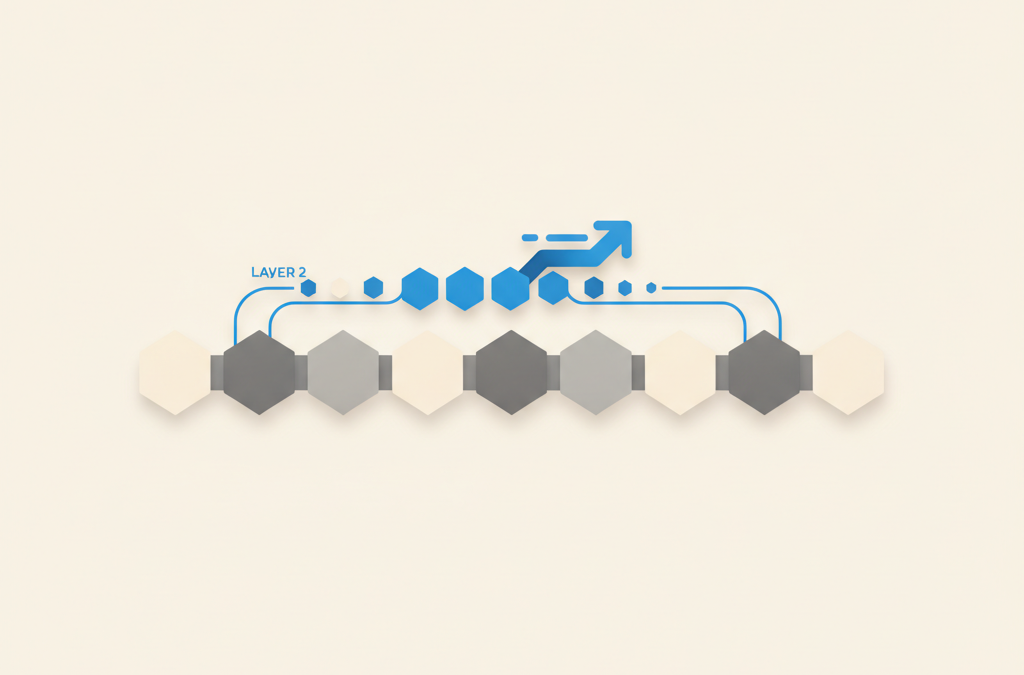
Most Layer 2s follow the same broad pattern. Many transactions are executed on the Layer 2 network, then bundled together and committed to the Layer 1. Instead of the main chain processing a thousand transactions individually, it records a compressed summary of all of them. The main chain does far less work, but it still holds enough information to keep the system honest.
The dominant design today is the rollup. A rollup executes transactions off-chain, then “rolls up” many of them into a single batch and posts that batch’s data to the Layer 1. Because the transaction data is available on the base chain, anyone can reconstruct the Layer 2’s state and challenge fraud. That is the property that lets a rollup inherit the base chain’s security rather than inventing its own.
A useful way to picture it: the Layer 1 does not re-run every Layer 2 transaction. It stores enough information about them, and either a proof or a challenge mechanism, so that if the Layer 2 operator ever lies, the truth can be reconstructed and enforced on the base chain. The main chain becomes a court of final appeal rather than a clerk processing every payment by hand. That is what makes the arrangement both cheap and trustworthy at the same time.
The two main rollup types
Rollups differ mainly in how they convince the Layer 1 that their batches are valid.
- Optimistic rollups. These assume batches are valid by default and allow a challenge window during which anyone can submit a fraud proof if something is wrong. If the window passes unchallenged, the batch is accepted. The trade-off is a waiting period for withdrawals back to Layer 1.
- Zero-knowledge (ZK) rollups. These generate a cryptographic validity proof for each batch and post it to the Layer 1, which can verify the proof mathematically. There is no need to wait out a challenge window, because the proof itself demonstrates correctness.
Both are Layer 2 in crypto in the strict sense, because both derive their security from data or proofs committed to the base chain. Ethereum’s documentation describes Layer 2 precisely this way: a separate blockchain that extends the base layer and inherits its security guarantees.
Layer 2 vs sidechain
This is the distinction most people get wrong, and it changes your risk. A sidechain is an independent chain with its own consensus and its own validators. If a sidechain’s validators fail or collude, the main chain cannot help you recover. A Layer 2, by contrast, posts its data or proofs to the Layer 1, so users can generally exit using base-chain data even if the Layer 2’s operator misbehaves.
| Question | Layer 2 (rollup) | Sidechain |
|---|---|---|
| Where does security come from? | The Layer 1 it settles to | Its own consensus |
| Is transaction data on the base chain? | Yes (or provably available) | No |
| Can you exit if the operator fails? | Usually, via Layer 1 data | Not necessarily |
In short, “Layer 2” is a claim about inheriting Layer 1 security, not just about being a faster chain. When a project calls itself a Layer 2, it is worth checking whether it truly posts its data to the base chain or is really a sidechain with its own trust assumptions.
Moving funds to and from Layer 2
You reach a Layer 2 through a bridge. You deposit an asset on the Layer 1, and it becomes usable on the Layer 2; to leave, you withdraw back to the base chain. Optimistic rollups add a challenge-window delay on withdrawals, while ZK rollups can finalise faster once their proof is verified. Bridges are a sensitive component in any layered system, so it is worth understanding how crypto bridges work and why they get hacked before moving large amounts.
One term you will meet is the sequencer, the component that orders and batches Layer 2 transactions. Today many rollups run a single sequencer, which is efficient but is also a point of centralisation: if it goes offline, transactions can stall. The important safety property is that even if the sequencer misbehaves or disappears, a well-designed rollup still lets users force their transactions or withdraw through the Layer 1, because the necessary data lives on the base chain. When you assess a Layer 2, “what happens if the sequencer fails?” is one of the sharper questions to ask.
What Layer 2 does and doesn’t change
Layer 2 is genuinely useful, but it is not magic. Here is a grounded view:
- It lowers fees and raises throughput by taking work off the base chain.
- It keeps the base chain as the source of truth, so a well-built rollup does not ask you to trust a brand-new validator set.
- It introduces its own moving parts — sequencers, bridges, proof systems — each of which has to be sound.
- Withdrawal timing varies, so an optimistic rollup’s exit can take time by design.
- Not every “Layer 2” is equally decentralised yet, so the label alone does not tell you how much you are trusting the operator today versus the base chain.
It also helps to keep the vocabulary straight, because marketing blurs it. “Layer 1” is the base blockchain, the settlement layer. “Layer 2” sits on top and settles down to it. Terms like “sidechain,” “rollup,” “validium” and “app-chain” describe different points on a spectrum of how much a network borrows the base chain’s security versus providing its own. When you can place a project on that spectrum, the branding matters far less than where its data lives and how you would get your funds out if the operator vanished.
The bottom line
Layer 2 in crypto is the mainstream approach to scaling: process transactions off the main chain, then anchor them back to it so the base layer’s security still stands behind you. The most important habit is to check whether something billed as a Layer 2 actually settles its data to the Layer 1, because that single property is what separates a true Layer 2 from a sidechain wearing the label. Once you can tell them apart, you can judge for yourself where the real trust is placed.
Sources
Frequently asked questions
What is Layer 2 in crypto in one sentence?
It is a network built on top of a main blockchain that processes transactions off-chain and settles them back to the base layer, giving lower fees and higher throughput while relying on the Layer 1's security.
What is the difference between optimistic and ZK rollups?
Optimistic rollups assume batches are valid and allow a challenge period for fraud proofs, while ZK rollups post a cryptographic validity proof for each batch that the Layer 1 can verify immediately.
Is a Layer 2 the same as a sidechain?
No. A Layer 2 inherits security from the Layer 1 it posts data to, while a sidechain runs its own consensus and secures itself independently.
Related
what is a dao
Discover what a DAO is and how it operates as a decentralized autonomous organization using blockchain technology.
what is a rug pull and how to avoid one
Learn what is a rug pull in crypto and how to identify and avoid these scams to protect your investments.
How crypto regulation differs by jurisdiction
Crypto regulation differs by jurisdiction: why the same token can be a security, commodity or property, and how licensing, tax…