What a blockchain actually is, without the metaphors
A blockchain is a shared, tamper-evident database that many computers keep identical copies of — here is how that actually works, minus the metaphors.
Quick answer
A blockchain is a database copied across many independent computers. Records are grouped into blocks, and each block is cryptographically linked to the one before it. That linking, plus a shared consensus rule, lets parties who don't trust each other agree on one history that's hard to alter afterwards.
Key points
- Records are stored in linked blocks, not editable rows
- Many computers hold identical copies, so there is no single owner
- A consensus rule decides which new block is valid
- "Immutable" means altering history is expensive, not impossible
- Blockchains are public and pseudonymous, not anonymous
A blockchain is a shared database that lots of independent computers keep identical copies of. New records arrive in batches called blocks, and each block is cryptographically tied to the one before it. That link, paired with a rule for agreeing which block comes next, is what lets people who don’t trust each other still agree on one tamper-evident history — say, who owns which coins. Strip away the buzzwords and that’s the whole idea.
The problem a blockchain solves
An ordinary database has an administrator who can change any row, any time. That’s completely fine when everyone trusts the administrator — your bank, for instance, and nobody loses sleep over it. A blockchain is built for the opposite situation: participants don’t want to rely on a single operator, yet they still need to agree on one shared set of facts. So the real design question isn’t “how do we store data.” Databases have nailed that for decades. It’s “how do we agree on the data without a referee everyone has to trust.” Get that reframing straight and the rest of the design starts to make sense.
Think about the failure mode it’s guarding against. In a system with one operator, that operator can quietly rewrite a balance, reverse a payment, or freeze an account — and you’d have to take their word that they didn’t. Remove the trusted operator and suddenly you need another way to stop cheating. That “other way” is the machinery below.
Blocks and the chain
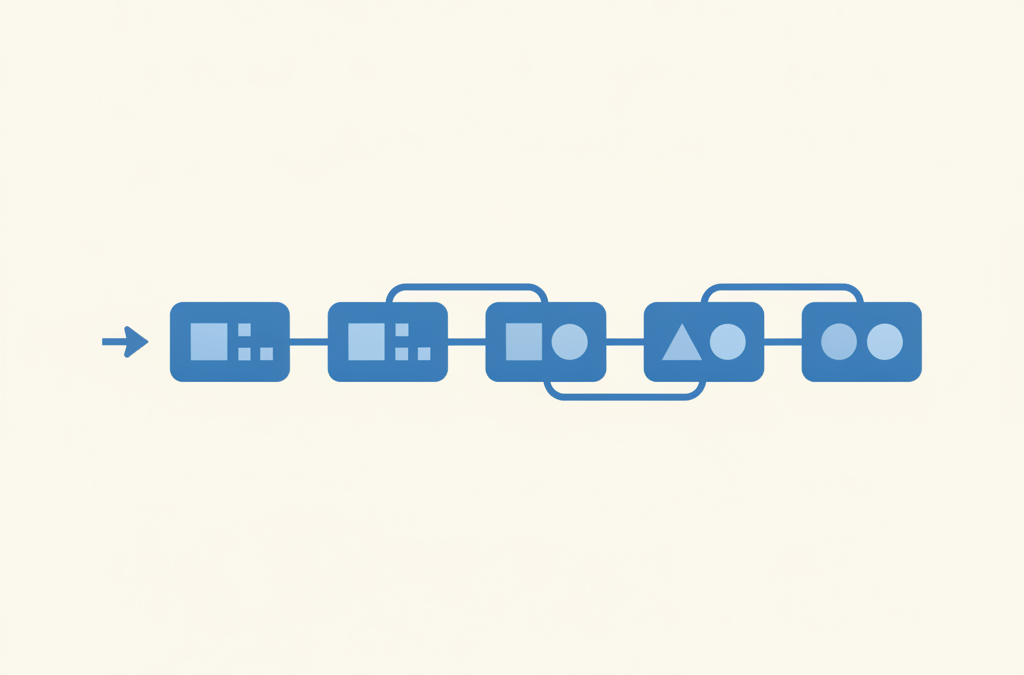
Transactions get grouped into a block. Each block carries a compact fingerprint of its own contents and — this is the crucial bit — the fingerprint of the previous block. That fingerprint comes from a cryptographic hash function, which turns any input into a fixed-length string and changes completely the instant a single character of the input changes. Because every block embeds the previous block’s hash, the blocks form a chain. Alter an old block and its hash changes, which breaks the link stored in the next block, which breaks the next, and the next. The history is tamper-evident: you can’t quietly edit the past without the edit showing up downstream.
A rough analogy helps. Imagine a stack of numbered pages where every page copies down a fingerprint of the page beneath it. Change one word on page 4 and its fingerprint no longer matches the copy written on page 5 — and page 6 references page 5, and so on up the stack. One quiet change ripples all the way to the top, in plain sight. That’s the mechanism, minus the maths.
Why no single computer is in charge
Copies of the chain live across a peer-to-peer network of computers called nodes. There’s no master copy — that’s not a detail, it’s the point. When someone broadcasts a new transaction, nodes pass it along to each other, and the network works toward agreement on which transactions go into the next block. And because every node can independently check the rules — valid signatures, no double-spends, correct linking — nobody has to be trusted individually. That’s what people mean by “decentralised”: authority over the record is spread across the network rather than parked with one operator.
One practical upshot: a node that tries to slip in an invalid transaction simply gets ignored. Its neighbours run the same checks, see the rule break, and drop it. Honesty isn’t enforced by good manners. It’s enforced by every participant verifying for themselves.
This is also where the word “trustless” comes from, and it’s a bit of a misnomer. You’re not trusting nobody. You’re trusting the rules and the maths instead of trusting a person or a company to behave. The shift is subtle but it’s the whole reason the design exists — you replace “trust the operator” with “check it yourself,” and anyone can run a node and do exactly that.
Agreeing on the next block
The hardest part is deciding whose block goes next, since plenty of nodes might propose one at the same moment. That’s the job of a consensus mechanism. Proof of work makes proposing a block costly by demanding a heap of computation — so rewriting history would mean out-computing the entire honest network. Proof of stake instead makes proposers put up economic value that gets destroyed if they cheat. Different networks strike different trade-offs, but the aim never changes: make honest agreement the easiest and most profitable path, and make dishonesty expensive enough that nobody sane attempts it.
What “immutable” really means
Blockchains get called immutable constantly, but the word oversells it. A more honest version: changing a confirmed block would mean redoing the work (or restaking) for that block and every block after it, faster than the rest of the network keeps extending the honest chain. On a large, well-distributed network that’s so expensive it’s impractical, which is why deep history gets treated as effectively permanent. But notice what that really is — a matter of cost and probability, not a law of physics. On a small or poorly distributed network, that cost can drop low enough to actually matter. “Immutable” is really “prohibitively expensive to change,” and the two aren’t the same claim.
What a blockchain is not
Three misconceptions are worth clearing up before they cause trouble. First, blockchains are usually not anonymous. Most are pseudonymous and fully public, so anyone can read every transaction, and addresses can often be linked back to real identities. Second, they’re not free. Someone pays — in electricity or staked capital — for the security, which is exactly why fees exist. Third, and this is the one that trips up newcomers, a blockchain does not make the data true. It secures the record of what was written, not the honesty of whoever wrote it. Record a lie on-chain and the blockchain will faithfully preserve that lie forever, with the same cryptographic diligence it gives the truth.
What this means
Peel off the metaphors and a blockchain is a specific engineering answer to a specific problem: keeping a shared record honest when no trusted party is in charge. It pulls that off with three ingredients working in concert — hashing to make history tamper-evident, a peer-to-peer network so there’s no single point of control, and a consensus rule so the network can agree without a referee. Grasp those three pieces and you can reason about almost any blockchain system, and see straight through anyone using the word to mean “magically trustworthy.” Want to go deeper? Read how miners and validators actually do this work, and how to read a block explorer to watch it happen in real time.
Sources
Frequently asked questions
Is a blockchain the same as Bitcoin?
No. Bitcoin is one system that uses a blockchain. A blockchain is the underlying record-keeping structure, which many different networks use in different ways.
Can data on a blockchain be deleted?
Not in the normal sense. Because each block is linked to the next, changing or removing old data would require redoing all the work since — which is why public blockchains are treated as practically tamper-resistant.
Related
What Is a Crypto Wallet?
Discover what is a crypto wallet and how it securely stores your digital assets. Learn about different types and their…
What Is Staking in Crypto?
Discover what staking is in crypto, how it works, and its benefits for blockchain networks and users.
What is a crypto bridge (and why they get hacked)?
A crypto bridge moves assets between blockchains by locking and minting wrapped tokens. Learn how a crypto bridge works, and…