Proof of work vs proof of stake, mechanically
Proof of work secures a blockchain with computing power; proof of stake secures it with capital at risk. Here is how each mechanism works, side by side.
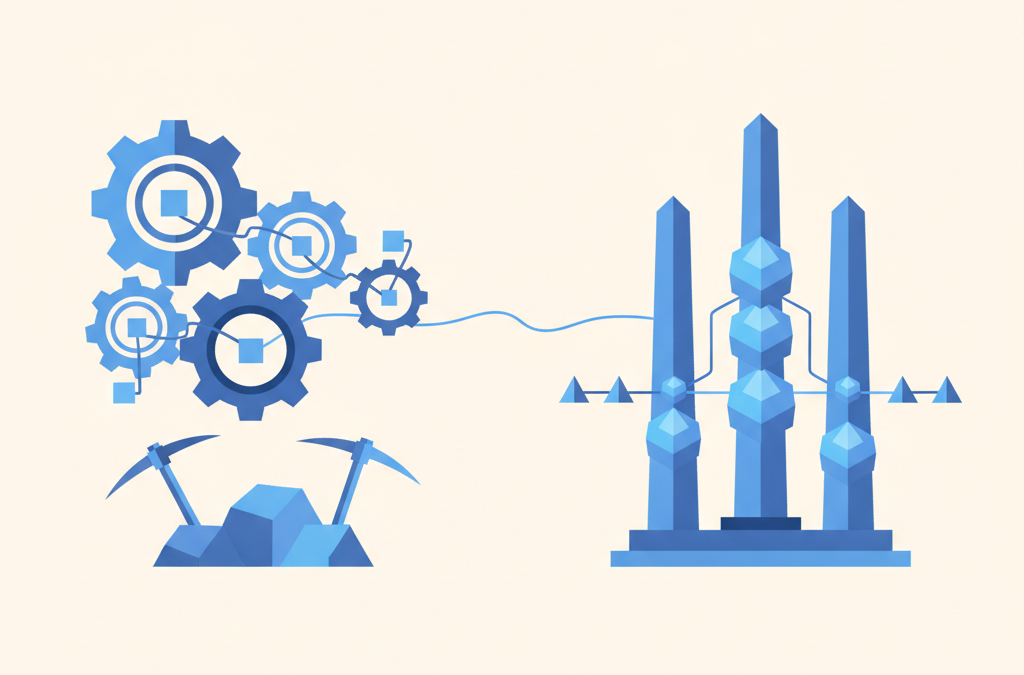
Quick answer
Both mechanisms attach a real cost to influencing the ledger so cheating is irrational. Proof of work requires solving an expensive computational puzzle; proof of stake requires locking up capital that can be destroyed for misbehaving. They differ in energy use, cost profile and how quickly transactions become final.
Key points
- Both make influencing the ledger costly to prevent Sybil attacks
- Proof of work commits computing power; proof of stake commits capital
- Attacks require a majority of hash power or a large share of stake
- Proof of stake uses far less energy but locks up capital
- Many proof-of-stake designs add explicit, faster finality
Proof of work and proof of stake are two ways a blockchain decides who adds the next block and how the network agrees it is valid. Proof of work makes block production expensive by requiring real computation. Proof of stake makes it expensive by requiring participants to put their own funds at risk. Both aim for the same result — honest block production as the most rational choice — through different costs.
The problem both are solving
A public blockchain has no central administrator, yet anyone can join anonymously. That creates a specific danger: a single actor could spin up thousands of fake identities to outvote everyone and control the ledger. This is known as a Sybil attack. Simple one-identity-one-vote schemes are therefore useless, because identities are free to create.
Both proof of work and proof of stake solve this by attaching a real-world cost to influence. You cannot get more say by inventing more identities; you get more say only by committing more of a scarce resource. In proof of work that resource is computation; in proof of stake it is capital. Everything else follows from that single design choice.
Proof of work, mechanically
In proof of work, participants called miners compete to add each block by searching for a solution to a computational puzzle. The puzzle asks them to run the block’s contents through a hash function repeatedly, adjusting a value each time, until the output falls below a difficulty target. Finding a solution requires vast numbers of attempts; verifying one takes a single check. Whoever finds it first proposes the block and collects the reward.
The security comes from that expended effort. The network follows the chain with the most accumulated work, so to rewrite a past block an attacker must redo its puzzle and every puzzle since, while the rest of the network keeps extending the honest chain. Doing so would require controlling a majority of the network’s total computing power — the widely cited “51% attack.” The cost of acquiring and running that much hardware is what makes the attack impractical on a large network.
The difficulty automatically adjusts so blocks arrive at a steady average rate, no matter how much mining power is present. The unavoidable trade-off is energy: the security is literally purchased with electricity, which is why proof-of-work networks consume significant power.
Proof of stake, mechanically
In proof of stake, participants called validators lock up a deposit of the network’s own currency as a bond. The protocol selects validators to propose and attest to blocks, weighting selection by how much each has staked. There is no puzzle to solve, so no large-scale computation is involved — a validator’s node mainly needs to be online and follow the rules.
Honesty is enforced economically. A validator that follows the protocol earns rewards; one that misbehaves — such as proposing two conflicting blocks — can have part or all of its stake destroyed, a penalty called slashing. To attack the chain, an actor would need to control a large fraction of the total staked value, and doing so would put that entire stake at risk of being slashed. The deterrent is that a successful attack would likely destroy the very holdings used to mount it.
Because there is no computational race, energy use is far lower. The cost shifts from ongoing electricity to capital that must be locked up and kept at risk. Ethereum moved from proof of work to proof of stake in 2022, an event often called “the Merge,” which is the highest-profile example of a network changing mechanisms.
Side by side
| Proof of work | Proof of stake | |
|---|---|---|
| Scarce resource committed | Computing power | Staked capital |
| How a block is won | Solving a hashing puzzle | Being selected, weighted by stake |
| Attack requires controlling | A majority of computing power | A large share of staked value |
| Main deterrent | Cost of hardware and electricity | Risk of losing the stake (slashing) |
| Energy use | High | Comparatively low |
| Cost profile | Ongoing operating cost | Capital locked and at risk |
The people running each system — miners and validators — are covered in what miners and validators actually do.
Finality: a real mechanical difference
One concrete distinction worth understanding is finality. In classic proof of work, a block is never absolutely final; it just becomes exponentially less likely to be reversed as more blocks pile on top. This is why receivers wait for multiple confirmations, as explained in how a crypto transaction gets confirmed.
Many proof-of-stake designs add an explicit finality step: after a certain point, validators collectively commit to a block in a way that cannot be reversed without a large share of them being slashed. Past that point, reversing the block is not merely improbable but economically ruinous for the attackers. This gives a sharper, faster notion of “settled” than pure proof of work provides.
A design problem unique to proof of stake
Because proof of stake replaces physical cost with a bond, it has to solve a subtle problem that proof of work does not. In proof of work, building on a competing version of history means splitting your computing power, so you cannot cheaply support two chains at once — the physical cost forces you to pick one. In proof of stake, validating a block is cheap, so in a naive design a validator could support every competing version of history at no extra cost, hoping to be rewarded whichever one wins. This is known as the “nothing at stake” problem.
Proof-of-stake protocols address it precisely through penalties. By making a validator’s stake slashable if it signs conflicting blocks, the protocol reintroduces a real cost for hedging across multiple histories: doing so now risks destroying the bond. In effect, slashing manufactures the “you must commit to one chain” property that physical work provides for free in proof of work. Understanding this makes clear why slashing is not an incidental feature but the mechanical heart of how proof of stake stays secure — it is what stops the low cost of validating from becoming a way to game the system.
Trade-offs, not a winner
Neither mechanism is simply superior; they optimise for different things. A few honest points of comparison:
- Energy versus capital. Proof of work spends energy continuously; proof of stake ties up capital. Which “cost” is preferable is partly a values question, not just a technical one.
- Barriers to entry. Mining favours those with cheap electricity and hardware access; staking favours those who already hold enough of the currency. Both can tend toward concentration in different ways.
- Maturity and simplicity. Proof of work is older and conceptually simpler, with a long track record. Proof of stake is more complex but avoids the energy burden.
Different networks make different choices, and some experiment with hybrids or entirely different schemes. There is no consensus that one is correct for every use.
What this means
Strip away the branding and both mechanisms do one thing: they make it costly to influence the ledger, so that gaming it would cost more than it could yield. Proof of work buys that cost with electricity and hardware; proof of stake buys it with capital placed at risk. Knowing which resource secures a given network tells you a lot about its energy footprint, its attack surface, and how quickly its transactions become final. If the underlying ledger both mechanisms maintain is still fuzzy, begin with what a blockchain actually is.
Sources
Frequently asked questions
Is proof of stake more secure than proof of work?
Neither is simply more secure; they attach cost to attacking in different ways. Proof of work relies on the expense of computing power, while proof of stake relies on the risk of losing staked capital through slashing.
Why did Ethereum switch to proof of stake?
Ethereum transitioned to proof of stake in 2022, an event known as the Merge, primarily to reduce the energy consumption associated with proof-of-work mining.
What is a 51% attack?
It is an attack in which a single actor controls a majority of a network's block-producing resource, computing power in proof of work, allowing them to rewrite recent history. On large networks the cost of doing so makes it impractical.
Related
what is cold storage
Discover what is cold storage in crypto, its types, and how it enhances security for digital assets.
What Is a Gas Fee in Ethereum?
Discover what a gas fee is in Ethereum, how it works, and why it's important for blockchain transactions.

What miners and validators actually do
Miners and validators add new blocks and keep a blockchain in agreement. They do the same job but earn the…