How a crypto transaction gets confirmed
A crypto transaction is confirmed when a block includes it and more blocks build on top. Here is how a payment goes from signed and broadcast to settled.
Quick answer
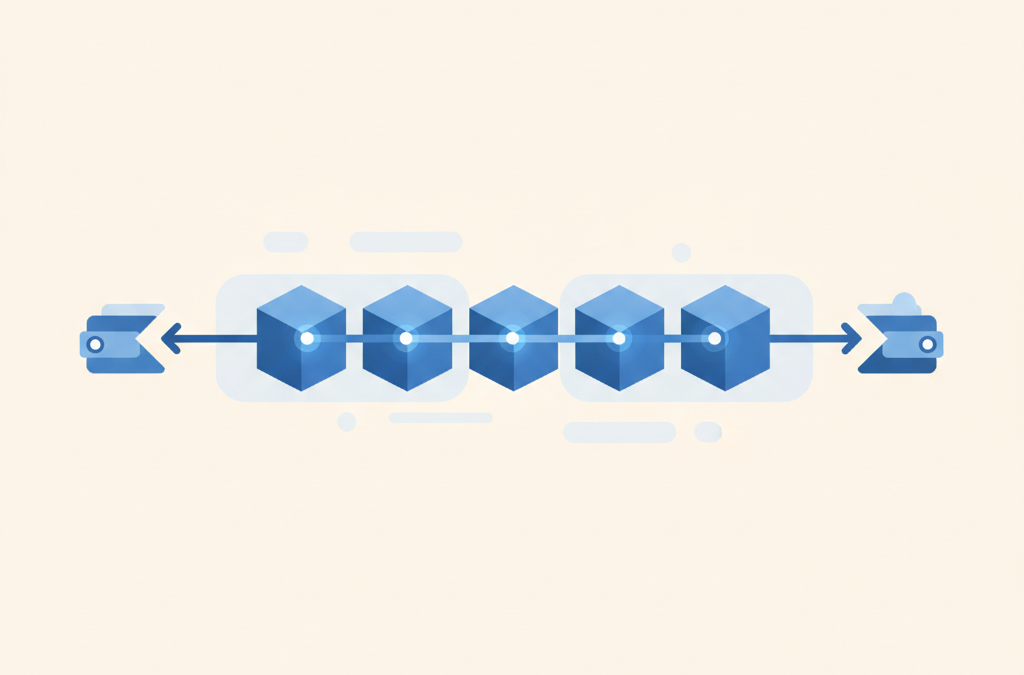
A transaction is confirmed when the network includes it in a block, and each additional block built on top adds another confirmation. Signing and broadcasting only announce a payment; confirmation is the separate process that settles it and makes reversal progressively harder as more blocks accumulate.
Key points
- Signing and broadcasting only announce a transaction, they do not settle it
- Unconfirmed transactions wait in the mempool until a block includes them
- Higher fees generally mean faster inclusion and confirmation
- Each block built on top adds another confirmation and more security
- The receiver decides how many confirmations to require before settling
A crypto transaction gets confirmed when the network includes it in a block and then builds further blocks on top of that one. Signing and broadcasting a payment is only the first step; confirmation is the separate process by which the network agrees the payment happened and makes it progressively harder to reverse.
From your wallet to the network
A transaction begins in your wallet. You specify a destination address and an amount, and your wallet assembles the transaction and signs it with your private key. That signature proves you control the funds without revealing the key itself — the mechanics of which we cover in public and private keys, explained properly.
Your wallet then broadcasts the signed transaction to a node it connects to. That node checks the transaction is well-formed and validly signed, and if so, relays it to its peers. Within seconds the transaction propagates across thousands of nodes. At this point the payment exists and is visible, but it is unconfirmed: it has been announced, not yet settled.
The mempool: a waiting room
Each node keeps a pool of valid, unconfirmed transactions it has heard about, commonly called the mempool (memory pool). Think of it as a waiting room. Transactions sit there until whoever produces the next block selects them for inclusion.
Block producers are not obliged to take transactions in the order they arrived. Because block space is limited, they generally prioritise transactions offering higher fees, since fees are part of their reward. This is why the fee you attach affects how quickly you are confirmed: in busy periods, a low-fee transaction can wait a long time in the mempool while higher-fee ones are picked ahead of it. What those fees actually pay for is covered in what gas fees actually pay for.
Getting into a block
Periodically, a participant assembles a candidate block — a batch of transactions from the mempool — and, if the network’s rules accept it, that block is added to the chain. Who gets to produce the block, and how the network agrees on it, depends on the consensus mechanism. Under proof of work a miner must find a valid solution; under proof of stake a validator is chosen to propose the block. Either way, the job of gathering and ordering transactions is done by these participants, whose role we explain in what miners and validators actually do.
Once your transaction is included in a block that the network accepts, it has its first confirmation. The funds have now moved on the shared ledger. But one confirmation is not the end of the story.
Why “confirmations” are plural
A single block can, in rare cases, be replaced. Two producers may briefly create competing blocks at the same height, and the network resolves the split by continuing to build on one of them; the other is discarded, and any transaction that was only in the discarded block returns to the mempool. This is normal and self-correcting, but it means a transaction with just one confirmation is not yet final.
Each additional block built on top of the one containing your transaction is another confirmation. To reverse a transaction buried under several blocks, an attacker would have to rebuild all of those blocks faster than the rest of the network extends the honest chain — which becomes exponentially harder with each block. That is why exchanges and merchants wait for a number of confirmations before treating a deposit as settled: more confirmations mean more accumulated work or stake standing behind the transaction, and a vanishingly small chance of reversal.
How many confirmations is “enough”?
There is no universal number, and it depends on the network and on how much value is at stake. A small payment might be treated as settled quickly, while a large transfer warrants waiting longer. Some networks also offer stronger guarantees than others: certain proof-of-stake designs add a notion of finality, a point after which reversing a block would require penalising a large amount of staked value, making it economically prohibitive rather than merely improbable.
The practical rule is that “confirmed” is a spectrum, not a switch. The receiver — not the sender — decides how many confirmations they require before releasing goods or crediting an account, based on their own risk tolerance.
When a transaction seems stuck
Sometimes a transaction lingers in the mempool without being included. Usually the cause is a fee that is too low for current demand, so producers keep choosing other transactions. A few common outcomes:
- It eventually confirms. When demand falls, a lower fee may become acceptable and the transaction is picked up.
- It is dropped. Nodes may discard very old unconfirmed transactions from their mempool, after which it is as if the transaction was never sent and the funds are spendable again.
- It is replaced or accelerated. Some networks support mechanisms to resend the transaction with a higher fee. What is possible depends on the specific network and wallet.
Until a transaction is confirmed, treat it as pending. You can watch its status yourself, which is where a block explorer comes in — see how to read a block explorer.
Why confirmation speed varies by network
How long a confirmation takes depends heavily on which blockchain you are using, because networks produce blocks at different rhythms. Some are designed to add a block only every several minutes; others aim for a new block every few seconds. A network with slower blocks is not worse — the pace is a deliberate design choice balancing speed against stability — but it does mean your first confirmation can arrive quickly on one chain and take longer on another.
The number of confirmations a receiver waits for also interacts with block speed. On a chain with fast blocks, “six confirmations” accumulates in a short time; on a slower chain the same count takes longer but each block may carry more weight. This is why you cannot compare confirmation counts across different networks as if they meant the same thing. What matters is the total security standing behind your transaction, which is a combination of how many blocks have piled on top and how much work or stake each of those blocks represents. When you check a transaction’s status, the network’s normal block time tells you roughly how long the next confirmation should take.
A quick note on irreversibility
Once a transaction has several confirmations, it is effectively permanent — there is no central operator who can claw it back or reverse a mistake. This is a deliberate design property, not a flaw, but it changes how you should behave. Double-check the destination address and amount before signing, because after enough confirmations the payment cannot be undone by appealing to anyone. The safety net that card networks and banks provide simply is not part of the model.
What this means
Confirmation is the difference between a transaction being announced and being settled. Your signed payment enters a mempool, waits to be included in a block, and then gains security with every block built on top of it. Understanding the stages explains the everyday realities: why fees affect speed, why a deposit is not instantly available, and why you should verify details before sending. If you want the ground-level picture of the ledger all of this updates, start with what a blockchain actually is.
Sources
Frequently asked questions
Why is my transaction still unconfirmed?
Usually the attached fee is too low for current network demand, so block producers keep selecting higher-fee transactions ahead of it. It may confirm later when demand falls, or be dropped from the mempool entirely.
How many confirmations do I need?
There is no universal number. The receiver decides based on the network and the value at stake: small payments may be accepted quickly, while large transfers usually wait for more confirmations.
Can a confirmed transaction be reversed?
After several confirmations it is effectively permanent, and no central operator can undo it. This is why you should verify the address and amount carefully before signing.
Related

What Is a Paper Wallet? How It Works & Risks
A paper wallet is an offline printout of your crypto keys; it removes online hacking risk but adds physical loss,…
What Is a Vanity Address in Crypto?
A vanity address is a crypto address with a custom pattern; here is how they are made and the security…

What is cold storage in crypto?
Cold storage in crypto means keeping your private keys offline. Learn what cold storage is, how it protects your coins,…