What Is Proof of Reserves?
Proof of reserves is cryptographic evidence that a crypto custodian holds the assets it owes customers, though it rarely proves the full picture.
Not advice. This is educational information, not financial, investment, or tax advice. Rules differ by country and change often — consult a qualified professional in your jurisdiction before acting. See our risk disclaimer.
Quick answer
Proof of reserves (PoR) is a method for a crypto custodian, usually an exchange, to show with cryptographic evidence that it holds the assets it owes to customers. A typical proof pairs on-chain evidence of what the platform controls with a Merkle-tree snapshot of what it owes, so anyone can check the two sides roughly match.
Key points
- Proof of reserves shows that a custodian controls assets on-chain that match what it owes customers.
- The liabilities side is usually built as a Merkle tree, letting each user verify their balance is included without exposing others.
- A Merkle root is a single cryptographic fingerprint summarizing every customer balance in the snapshot.
- Proof of reserves is a point-in-time snapshot, not a continuous or forward-looking guarantee.
- Reserves alone are meaningless without liabilities, since a platform can hold assets and still owe far more.
- Proof of reserves is narrower than a full financial audit and does not confirm ownership, debts, or solvency by itself.
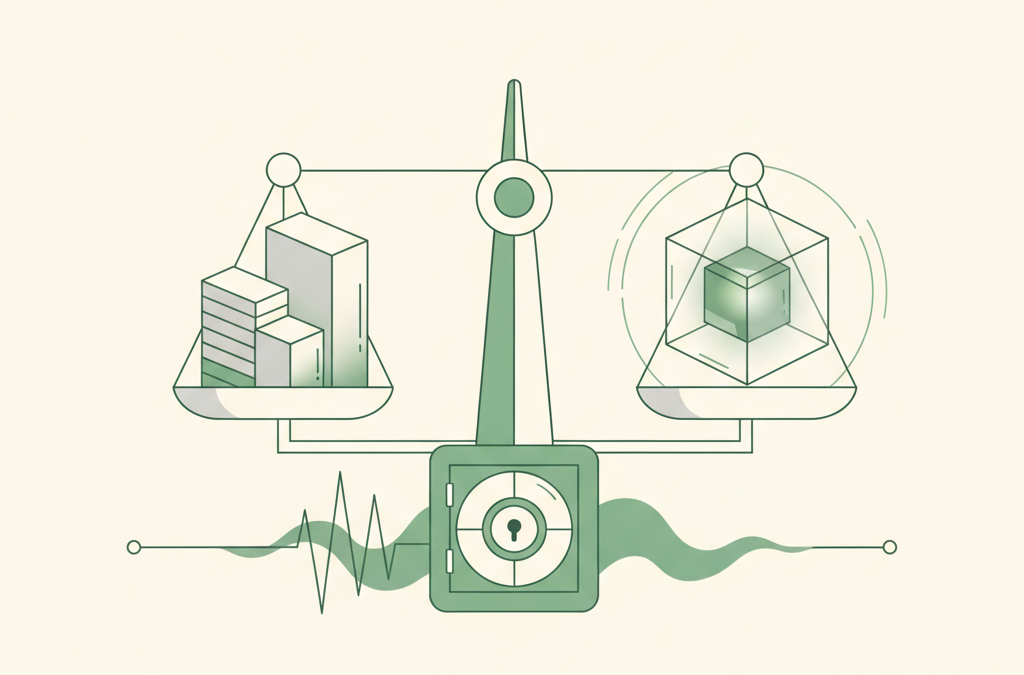
Proof of reserves (PoR) is a way for a custodian, usually a crypto exchange, to show with cryptographic evidence that it actually holds the assets it owes to its customers. A proper proof pairs on-chain evidence of what the platform controls with a snapshot of what it owes, so anyone can check that the two sides roughly line up.
The idea grew out of a hard lesson. When exchanges collapse, customers often discover the coins they thought were safely held were not there. Proof of reserves is an attempt to make that verifiable rather than a matter of trust. This is an educational explainer, not financial advice, and it does not endorse any platform. Rules differ by jurisdiction.
What problem does proof of reserves solve?
Trust. When you leave coins on an exchange, you do not hold them; the exchange does, and you hold a claim. You are trusting that the platform still controls enough assets to honor every claim at once. History says that trust is sometimes misplaced.
Proof of reserves tries to replace faith with evidence. Instead of taking a platform’s word, users get a way to check, for themselves, that their balance is part of a verified total.
How does proof of reserves work?
Two halves have to fit together. One shows the assets. The other shows the liabilities.
On the asset side, the platform demonstrates control of on-chain wallets, often by signing a message or moving funds, so an observer can confirm the coins exist and are controlled by the exchange. On the liabilities side, the platform must show what it owes every customer. That is the harder half, because it involves private balances.
This is where the Merkle tree comes in.
What is a Merkle tree, and why use one?
A Merkle tree is a structure that lets a platform prove a total without exposing individual accounts. Every customer balance is hashed into a unique fingerprint. Those fingerprints are paired and hashed again, over and over, up to a single value at the top called the Merkle root.
The root is a compact summary of every balance in the snapshot. Change one balance and the root changes. That is the useful property.
Each customer can then be handed a short proof, a Merkle proof, showing that their own balance is included in the root, without seeing anyone else’s numbers. You verify yourself; your neighbor stays private. A third party attests that the assets under the platform’s control exceed the total liabilities captured in that tree.
Proof of reserves vs a full audit
People often treat the two as the same thing. They are not. This table shows the gap.
| Feature | Proof of reserves | Full financial audit |
|---|---|---|
| Scope | On-chain assets vs customer balances | Whole set of books and controls |
| Method | Cryptographic snapshot plus attestation | Standards-based accounting review |
| Timing | Point in time | Period covered, with fieldwork |
| Covers off-chain debts? | Usually no | Yes, in principle |
| Confirms solvency? | Only partially | Closer, though never absolute |
An audit asks a broad question about the health of an entire business. Proof of reserves asks a narrow one: at this instant, do the on-chain assets cover the customer balances shown? Useful, but narrow.
Why do liabilities matter so much?
Because reserves without liabilities prove almost nothing. Imagine a platform waving a wallet holding a billion dollars in crypto. Impressive, until you learn it owes three billion to users. The billion is real; the platform is still deeply short.
So a proof that shows only the flattering half, the assets, is not really proof of reserves at all. It is a partial picture. A meaningful proof has to pin down the liabilities side too, which is exactly what the Merkle tree is for.
What does proof of reserves not tell you?
Quite a lot, and this is where people are misled.
It is a snapshot. A proof captures one moment. A platform could pass on Monday and be drained by Friday. Frequent, repeated proofs help, but no single snapshot is a live guarantee.
Borrowed assets can flatter it. A platform could borrow funds right before the snapshot to appear fully backed, then return them after. Without a broader review, that trick can slip through.
Off-chain debts stay hidden. Loans, obligations to partners, and other liabilities that never touch the blockchain sit outside a standard proof entirely.
Ownership is not the same as control. Signing from a wallet shows control at that moment, not that the assets are unencumbered or free of competing claims.
Newer approaches try to close some of these gaps, including cryptographic schemes that prove assets and liabilities while revealing even less private data. They tighten the method; they do not turn a snapshot into a full audit.
How often should a proof be published?
The more frequently, the more meaningful. A single proof is a photograph, not a video, so a platform that publishes once tells you very little about the months in between. Regular proofs, on a repeating schedule, turn isolated snapshots into something closer to a trend you can watch.
Independent involvement matters just as much as frequency. When a reputable third party attests to the assets and checks them against the liabilities in the Merkle tree, the proof carries far more weight than a figure a platform simply publishes about itself.
Even so, keep the ceiling in mind. Frequent, attested proofs raise confidence; they do not remove the need for the broader scrutiny that only a full audit and sound custody practices provide. The strongest programs pair recurring proofs with independent attestation rather than treating either one as enough on its own.
The bottom line
Proof of reserves is a genuine step up from blind trust: it lets you verify that a custodian controls assets matching the balances it reports, and it lets you check your own balance is counted. But treat it for what it is. A point-in-time, mostly on-chain snapshot, strongest when it includes liabilities and an independent attestation, and weakest when it shows only the assets. It is narrower than a full audit and never a solvency guarantee on its own. This explains how the mechanism works and where it falls short; it is not advice, and standards differ by jurisdiction.
Sources
Frequently asked questions
Does proof of reserves prove an exchange is solvent?
Only partly. Solvency means assets exceed liabilities. Proof of reserves can show assets and, when done properly, liabilities at one moment, but it does not capture off-chain debts, borrowed assets, or the picture a day later, so it is not a full solvency guarantee.
What is a Merkle tree in this context?
It is a data structure that hashes every customer balance and combines them upward into one value, the Merkle root. Each user can be given a proof showing their balance sits inside that root, without revealing anyone else's balance.
How is proof of reserves different from an audit?
A financial audit is a broad, standards-based review of a firm's books by an accounting firm. Proof of reserves is a narrower, mostly cryptographic check of on-chain assets against customer balances at a point in time. The two answer different questions.
Can proof of reserves be faked?
It can be gamed if it is incomplete. A platform could show assets while hiding liabilities, borrow funds briefly to pass the snapshot, or exclude some accounts. That is why independent attestation and inclusion of the liabilities side matter.
Is this financial advice?
No. This is an educational explainer about how proof of reserves works and its limits. It does not endorse any platform, rules differ by jurisdiction, and you should consult a qualified professional for financial decisions.
Related
How exchanges are licensed
How crypto exchanges are licensed: MiCA in the EU, layered US state and federal rules, UK FCA registration, and shared…
What Is APY in Crypto? APY vs APR
APY shows the yearly return on crypto including compounding, while APR excludes it, so APY looks higher when interest is…
What Is a Crypto Derivative?
A crypto derivative is a contract whose value derives from an underlying coin's price, used to speculate or hedge without…