What Is APY in Crypto? APY vs APR
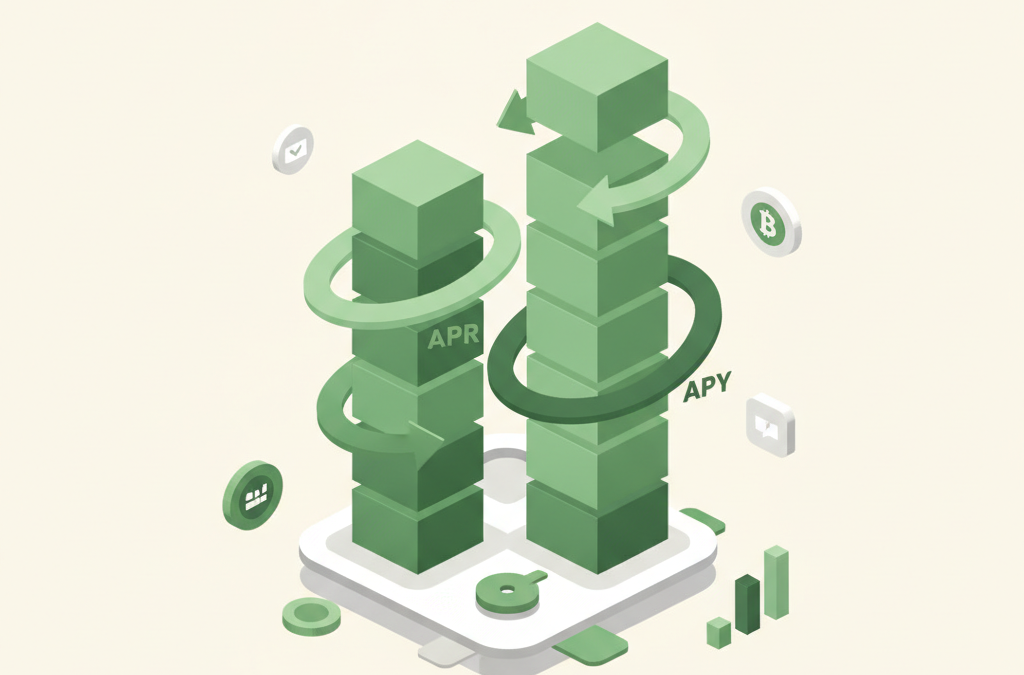
APY shows the yearly return on crypto including compounding, while APR excludes it, so APY looks higher when interest is reinvested.
Not advice. This is educational information, not financial, investment, or tax advice. Rules differ by country and change often — consult a qualified professional in your jurisdiction before acting. See our risk disclaimer.
Quick answer
APY, or annual percentage yield, is the rate of return earned on a crypto deposit over a year including the effect of compounding, meaning interest earned on previously earned interest. APR, or annual percentage rate, is a simple yearly rate that ignores compounding. Because of that difference, APY is usually higher than APR when returns are reinvested.
Key points
- APY (annual percentage yield) includes compounding; APR (annual percentage rate) does not.
- The more frequently rewards compound, the wider the gap between APY and APR becomes.
- Advertised rates are variable and can change quickly with market and protocol conditions.
- A quoted APY often assumes automatic reinvestment; manual claim-and-restake changes the real outcome.
- A high rate does not remove underlying risks such as smart-contract failure, slashing, or token price falls.
- APY and APR are educational concepts here, not a recommendation, and tax rules differ by jurisdiction.
APY, or annual percentage yield, is the rate of return earned on a crypto deposit over one year including the effect of compounding, which means earning returns on returns already received. It is the figure commonly shown for staking, lending, and savings-style products in crypto. APR, or annual percentage rate, measures a simple yearly rate that leaves compounding out, which is why the two numbers often differ.
Knowing which figure is being quoted helps a reader interpret advertised rates accurately. This article explains how APY and APR are calculated and how they differ. It is educational only and is not financial advice; yields are variable, risks are real, and tax and consumer-protection rules differ substantially by jurisdiction.
What is APY in crypto?
APY expresses the total yearly return on an asset assuming that rewards are reinvested and themselves start earning more rewards. That reinvestment is compounding, and it is the defining feature of APY. If a protocol pays out and automatically restakes rewards at regular intervals, the effective annual return climbs above the raw rate because each payout grows the base that the next one is calculated on.
In crypto, APY appears on staking dashboards, lending markets, and yield products. It is meant to represent the growth of a position over a year, which is why it is often the headline number a platform chooses to display.
What is APR in crypto?
APR is a simple annual rate that does not account for compounding. It answers a narrower question: what percentage is earned or charged over a year, treating each period independently, without reinvesting the returns along the way. Because it excludes the snowball effect of compounding, APR for the same underlying rate will be lower than the corresponding APY.
APR is frequently used to describe borrowing costs, while APY is more often used to describe earnings. That is a convention rather than a strict rule, so it always pays to check which figure a platform is actually quoting.
How does compounding create the difference?
The gap between APY and APR comes entirely from how often returns are reinvested. With APR, a 10% yearly rate simply pays 10% over the year. With APY, that same 10% base rate compounded more frequently pays slightly more, because interim rewards begin earning too.
The key relationship is that a higher compounding frequency produces a higher APY for the same base rate. Daily compounding yields a larger APY than monthly compounding, which in turn beats annual compounding. The base APR stays the same; only the reinvestment schedule changes the final figure.
A simple illustration makes the gap concrete. Suppose a product advertises a 12% APR. Left uncompounded, that is a flat 12% over the year. If instead the same 12% base rate is compounded monthly, the reinvested interest each month means the effective annual figure, the APY, ends up slightly above 12%. The higher the base rate and the more often it compounds, the more noticeable the difference becomes, which is why long-dated, frequently compounding positions show the widest gaps.
How is APY worked out?
APY is derived from the base rate and the number of compounding periods in a year. Conceptually, the periodic rate (the base rate divided by the number of periods) is applied repeatedly, and each application builds on the previous total rather than on the starting amount alone. The result is that the same nominal rate translates into a larger effective yearly return once compounding is included. Readers do not need to run the formula by hand, but knowing that APY bakes in this repeated reinvestment explains why it is the larger figure.
APY vs APR: what is the difference?
The table below summarizes how the two measures compare in practice.
| Aspect | APY | APR |
|---|---|---|
| Compounding | Included | Excluded |
| Typical use | Earnings on staking, lending, yield | Borrowing costs and simple rates |
| Relative size | Usually higher | Usually lower |
| Reflects | Effective annual return with reinvestment | Flat annual rate, no reinvestment |
| Sensitive to | How often rewards compound | Only the base rate and period |
Because the numbers can be presented to make a product look more attractive, comparing an APY on one platform with an APR on another is not a like-for-like comparison. Converting both to the same basis, or at least noting which is which, avoids being misled by the larger-looking figure.
Why does the distinction matter?
The distinction matters because APY and APR can describe the same underlying rate yet display very different headline numbers. A reader comparing two offers needs to know whether compounding is baked in, and if so how frequently, before deciding what the figures really mean.
It also matters because a quoted APY often assumes automatic, uninterrupted reinvestment. If a user has to claim and manually restake rewards, transaction costs and timing can mean the realized return falls short of the advertised APY. The number is a projection under ideal conditions, not a promise.
What are the risks and common misconceptions?
The most important misconception is that a high APY equals a good or safe opportunity. A headline rate says nothing about the safety of the platform, the reliability of the smart contracts, or the value of the token being paid out. Very high advertised yields can accompany higher risk, promotional periods that do not last, or reward tokens whose price can fall faster than the yield accrues.
Most crypto yields are also variable. Rates shift with demand, protocol settings, and market conditions, so a figure shown today may not hold tomorrow. Underlying hazards such as smart-contract bugs, slashing in staking, and general market volatility remain regardless of how the return is labeled. A yield figure measures potential reward, not risk.
Finally, earning yield can have tax consequences that vary by country and change over time. Because this is educational information and not financial or tax advice, anyone earning crypto rewards should consult a qualified professional about the rules that apply where they live.
The bottom line
APY and APR describe returns over a year, but APY includes compounding and APR does not, which is why APY usually looks higher. The size of the gap depends on how often rewards are reinvested. When comparing crypto products, the safest habit is to check which figure is quoted, whether compounding is automatic, and what risks sit behind the number, rather than chasing the largest percentage on the screen. This explainer covers the mechanics only and is not financial advice.
Sources
Frequently asked questions
Why is APY higher than APR?
APY is higher because it counts compounding, the effect of earning returns on returns already received. APR is a flat annual rate that ignores this. When the same base rate is compounded, say daily or weekly, the reinvested amounts add up, so the effective yearly figure (APY) exceeds the simple figure (APR).
Does a higher APY mean a better deal?
Not necessarily. A high APY can reflect higher underlying risk, a temporary promotional rate, or a token whose price may fall. The rate describes potential yield only; it says nothing about the safety of the platform or the value of the asset being earned, both of which matter as much as the headline number.
Are crypto APY rates guaranteed?
Generally no. Most crypto yields are variable and can change as demand, protocol parameters, and market conditions shift. A rate shown today may be different tomorrow, and some yields depend on reward tokens whose value is not fixed, so the realized return can differ from the advertised one.
Is earning crypto yield taxable?
In many jurisdictions, rewards from staking, lending, or similar activity can be taxable, sometimes as income when received and again on any later gain. Rules vary widely by country and change over time. This is not tax or financial advice; consult a qualified professional about the treatment where you live.
Related

How stablecoin regulation is developing
How stablecoin regulation is developing: the EU's MiCA, the evolving US approach, and common themes of reserves, redemption and disclosure…

How staking rewards are treated
How are staking rewards taxed? A clear guide to the two-layer pattern: income when you receive rewards, then capital gains…

Why bank transfers to exchanges get blocked
Why bank transfers to crypto exchanges get blocked: name mismatches, bank policies, verification limits and fraud checks, and how to…