What the bid-ask spread tells you
The bid-ask spread is the gap between the best buy and sell prices. Here is what the bid-ask spread tells you about a market's liquidity, cost and calm.
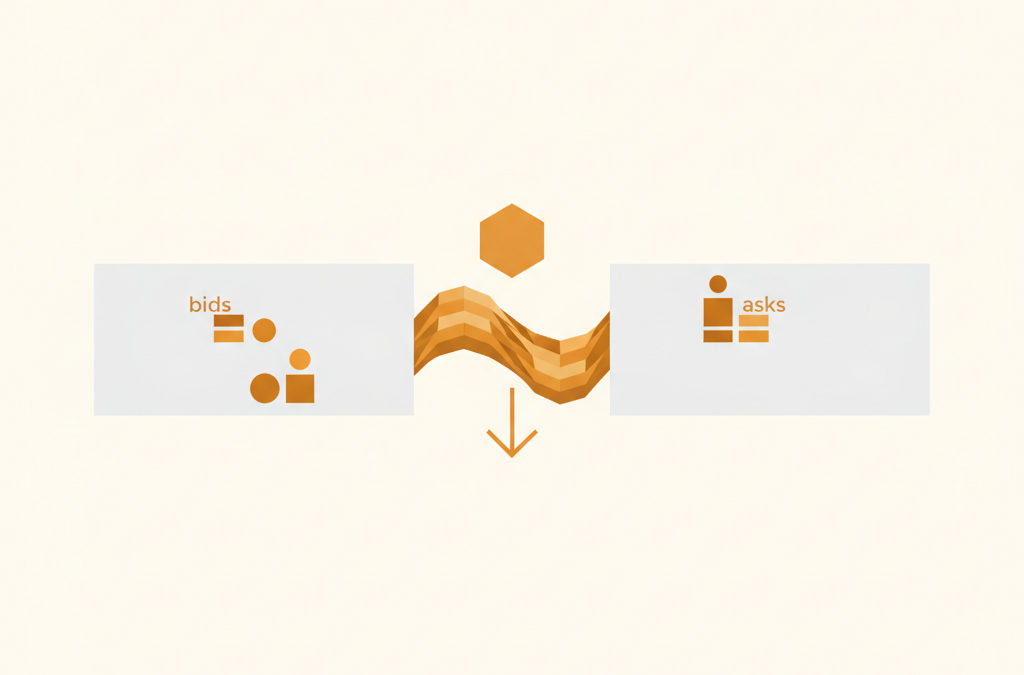
Mechanics, not signals. This explains how a market feature works. It is not a trading strategy, entry, target, or recommendation to buy or sell anything.
Quick answer
The bid-ask spread is the gap between the highest price a buyer will pay and the lowest a seller will accept. It is effectively the cost of trading immediately: a narrow spread signals a liquid, competitive market, while a wide spread signals thin liquidity or high volatility.
Key points
- The spread is the cost of trading immediately
- Narrow spreads signal high liquidity and competition
- Wide spreads signal thin liquidity or high volatility
- Compare spreads as a percentage of the mid-price
- Tick size sets a floor under how narrow a spread can be
The bid-ask spread is the gap between the highest price a buyer is willing to pay (the bid) and the lowest price a seller is willing to accept (the ask). It is one of the most information-dense numbers in any market, because it is effectively the price of trading right now — and its width quietly tells you how liquid, competitive, and calm a market is.
Where the spread comes from
In an order book, the best bid and best ask are the two prices closest to meeting in the middle. If the best bid is 100.0 and the best ask is 100.5, the spread is 0.5. These illustrative numbers describe the structure, not any real market. The spread exists because buyers and sellers rarely agree on an exact price; there is almost always a small no-man’s-land between what buyers will pay and what sellers will take.
That gap is not wasted space. It is where market makers earn their keep. A participant who continuously offers to buy at the bid and sell at the ask captures the spread as compensation for standing ready to trade with anyone, at any time, and for carrying the risk of holding inventory. The tighter the competition among these participants, the narrower the spread they can profitably quote.
How to read the width
The single most useful thing the spread tells you is how much it costs to trade immediately. If you buy at the ask and instantly sell at the bid, you lose the spread. So a wide spread is a direct, visible cost of round-tripping a position quickly, while a narrow spread means immediacy is cheap.
To compare across markets with different price levels, traders often look at the relative spread — the spread divided by the mid-price. A 0.5 gap on a 100 asset is a 0.5% relative spread; the same 0.5 gap on a 10,000 asset is only 0.005%. The absolute number alone can mislead; the percentage is what makes markets comparable.
What narrow and wide spreads signal
Narrow spreads generally accompany:
- High liquidity: many buyers and sellers are present, so the best bid and ask are pushed close together.
- Active competition: multiple market makers undercutting each other to be at the top of the book.
- Lower uncertainty: when the fair value is relatively agreed upon, sellers do not need a wide cushion.
Major, heavily traded assets on large venues tend to show very tight spreads for exactly these reasons.
By contrast, wide spreads tend to appear when:
- Liquidity is thin: few resting orders, so the nearest buyer and seller are far apart. This links directly to market depth.
- Volatility is high: when prices are moving fast, sellers widen their quotes to protect against being picked off, so the spread expands.
- Risk or uncertainty rises: around major news or in less-traded assets, market makers demand more compensation for the risk of holding inventory.
A wide spread is therefore not just a cost — it is a signal that the market is either quiet, nervous, or both.
Quoted, effective, and half-spread
The spread you see on screen — the gap between the best bid and best ask — is called the quoted spread. It describes the market for a small order at the very top of the book. But the price you actually achieve can differ, and analysts use a second measure to capture that: the effective spread. It compares the price you really traded at against the mid-price at the moment your order arrived, then doubles that difference to make it comparable to a quoted spread.
The two can diverge for a few mechanical reasons. A larger order walks into deeper levels and effectively pays more than the quoted spread. In a fast market, the book may have moved between the quote you saw and the moment of execution. Occasionally an order fills at a better price than the quote implied — for instance, matching against a hidden order resting inside the spread. The lesson is that the quoted spread is the advertised price of immediacy, while the effective spread is closer to what immediacy actually cost you.
A useful shorthand is the half-spread: half the gap between bid and ask, measured from the mid-price. Because a small buy pays the ask and a small sell receives the bid, a round trip — buy then immediately sell — costs roughly the full spread, or two half-spreads. Treating the half-spread as the baseline cost of getting into (or out of) a position makes it easy to compare venues and assets on a like-for-like basis, and to see at a glance when a market has become expensive to trade because its spread has widened.
The spread is also closely related to, but not the same as, slippage. The spread is the gap at the very top of the book for small trades. Slippage is the additional price movement a larger order suffers as it walks through deeper levels. A small order pays roughly half the spread relative to the mid-price; a large order pays the spread plus whatever slippage it incurs as it consumes liquidity. Both are costs of demanding immediacy, and both grow when a market is thin.
Mid-price, tick size, and quoting conventions
The point halfway between the bid and ask is the mid-price, and it is often used as a neutral reference for “the price” when a single figure is needed. It is worth remembering the mid-price is a convention, not a tradeable level — you generally cannot buy or sell there, because it sits inside the spread where no order is resting. When a data feed shows “the price” of an asset, it may be quoting the mid, the last traded price, or the best bid or ask, and these can differ slightly.
Related to quoting is the tick size. Every market has a tick size — the smallest price increment an order can be placed at. If the tick is 0.1, orders can sit at 100.0, 100.1, 100.2, and so on, but nothing in between. Tick size matters for the spread because the spread can never be narrower than one tick: the best bid and best ask must be at least one increment apart, or they would cross and trade. In very liquid markets, competition pushes the spread all the way down to a single tick, so the tick size effectively becomes the spread. A larger tick therefore enforces a wider minimum spread, while a smaller tick allows quotes to compress closer together. When comparing spreads across venues, it is worth checking their tick sizes, because part of a difference in spread can simply reflect a difference in how finely each venue lets prices be quoted rather than a difference in true liquidity.
Why spreads differ between venues
The same asset can show different spreads on different exchanges, because each venue has its own order book, its own set of market makers, and its own pool of liquidity. A large, busy venue often quotes a tighter spread than a small one. These structural differences are part of the reason quoted prices are not identical everywhere, explored in why prices differ between exchanges.
What this means
The bid-ask spread is best understood as the market’s live quote for immediacy. Read it three ways: as a cost (what you lose crossing it), as a percentage (to compare markets fairly), and as a signal (narrow means liquid and competitive, wide means thin or volatile). A common mistake is to treat the last traded price as “the” price while ignoring the spread around it — for anything but the smallest, most liquid markets, the spread is where the real cost of trading hides. This article explains a mechanism and is not trading advice.
Sources
Frequently asked questions
Is a narrow bid-ask spread always better?
A narrow spread means immediacy is cheaper and usually reflects a liquid, competitive market, but the spread is only one cost of trading; larger orders also face slippage beyond the spread.
Why do spreads widen during volatile periods?
When prices move quickly, the participants quoting bids and asks widen their quotes to protect against being filled at a stale price, so the gap between bid and ask expands.
Can I trade at the mid-price?
Generally no. The mid-price is the midpoint between the best bid and ask and is used as a reference, but no order is resting there, so it is not usually a price you can execute at.
Related

Impermanent loss, explained arithmetically
Impermanent loss is the shortfall a liquidity provider takes versus holding when pool prices diverge. See the exact constant-product math…

What Is Margin Trading in Crypto?
Crypto margin trading uses borrowed funds and collateral to open larger positions, which magnifies both gains and losses and adds…
What Is Dollar-Cost Averaging (DCA)?
Understand what crypto market cap is and how it is calculated. Learn its importance in the cryptocurrency market.