What Is a Soft Fork? Soft vs Hard Forks
A soft fork is a backward-compatible blockchain upgrade that tightens the rules, so old nodes still accept new blocks, unlike a chain-splitting hard fork.
Quick answer
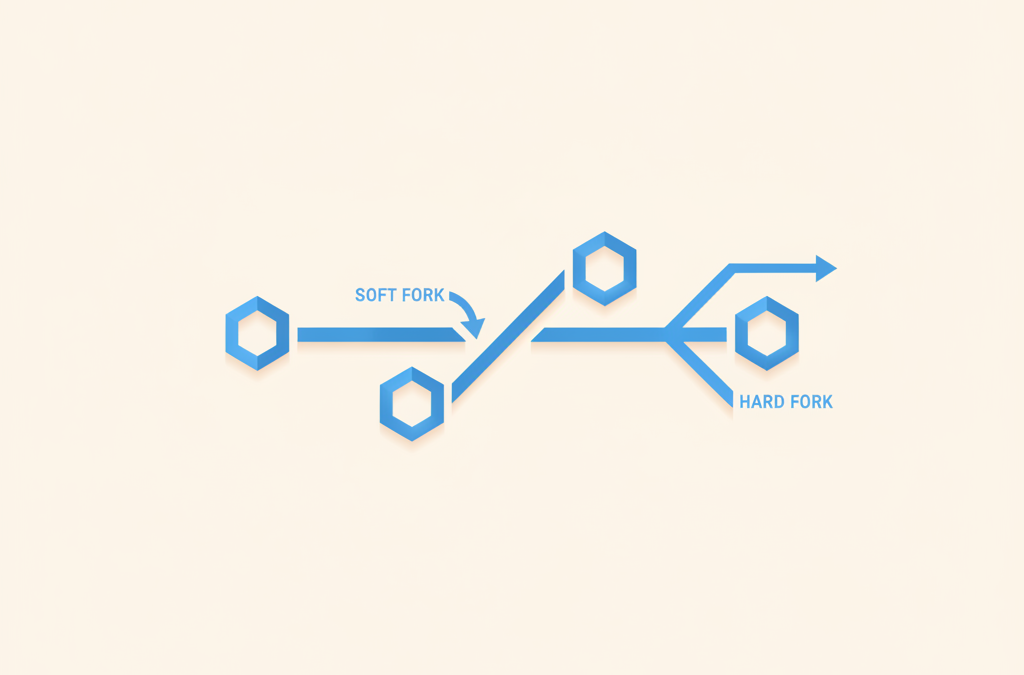
A soft fork is a backward-compatible change to a blockchain's rules. It tightens what counts as a valid block, so nodes that have not upgraded still accept the new blocks and stay on one chain. This contrasts with a hard fork, which loosens or changes rules in a way older nodes reject, often splitting the network into two chains.
Key points
- A soft fork is a backward-compatible protocol upgrade that makes the rules stricter, not looser.
- Non-upgraded nodes still accept blocks produced under a soft fork, so the network stays unified.
- A hard fork is not backward compatible and can permanently split a blockchain into two chains.
- Bitcoin's Segregated Witness (SegWit) is a widely cited example of a soft fork.
- Soft forks typically require majority support from block producers to activate smoothly.
- Hard forks require every participant who wants to follow the new chain to upgrade their software.
A soft fork is a backward-compatible change to a blockchain’s consensus rules. It tightens what counts as a valid block, so nodes running the older software still accept blocks made under the new rules. Because everyone continues to recognize the same blocks, the network stays as a single chain.
This is the key contrast with a hard fork, which changes the rules in a way older nodes reject. Understanding the difference explains why some upgrades pass quietly while others create entirely new coins.
What is a fork in a blockchain?
A fork is any change to the shared rules that define which blocks and transactions a network considers valid. Because a blockchain is maintained by many independent nodes running the same software, all of them must agree on those rules to stay on one chain.
When the rules change, nodes can end up disagreeing about whether a given block is valid. How that disagreement is resolved, or avoided, is what separates a soft fork from a hard fork.
It helps to remember that a blockchain has no central administrator to push an update to everyone at once. Each node operator chooses when, or whether, to upgrade. A protocol change therefore has to account for the reality that some nodes will run old software for a long time, and the two fork types handle that reality very differently.
How does a soft fork work?
A soft fork works by making the rules stricter, so the set of blocks that are valid under the new rules is a subset of what was valid before. Anything acceptable under the new, tighter rules was already acceptable under the old ones.
Because of that, non-upgraded nodes keep accepting new blocks without realizing the rules have tightened. They see nothing invalid, so they follow the same chain as upgraded nodes. Upgraded nodes, meanwhile, enforce the extra constraints.
For the upgrade to hold, a majority of block producers generally needs to adopt the new rules. Once most blocks follow the stricter standard, the tighter rules become the effective norm and the network converges on one chain.
A simple way to picture it: imagine a rule that says addresses may be at most 40 characters, then a soft fork tightens it to at most 30. Every 30-character address still satisfies the old 40-character rule, so old nodes never see anything they consider invalid. The reverse change, allowing 50-character addresses, would be a hard fork, because old nodes would reject the longer addresses outright.
How does a hard fork work?
A hard fork loosens or otherwise changes the rules so that blocks valid under the new software are rejected by old software. This is not backward compatible: any node that has not upgraded will refuse the new blocks.
If some participants upgrade and others refuse, the chain can permanently split into two networks that share history up to the fork but diverge afterward. Bitcoin and Bitcoin Cash are a well-known result of this kind of split. To follow the new chain, every user must actively upgrade.
Soft fork vs hard fork: what is the difference?
The core difference is backward compatibility. A soft fork tightens rules and keeps old nodes on the chain; a hard fork changes rules in a way that can force a split. The table summarizes the distinctions.
| Aspect | Soft Fork | Hard Fork |
|---|---|---|
| Backward compatible | Yes | No |
| Rule change | Tightens (adds restrictions) | Loosens or changes rules |
| Do all nodes must upgrade | No; old nodes still follow | Yes, to stay on the new chain |
| Chain split risk | Low | High; can create two chains |
| Typical use | Adding features, fixes | Major, incompatible changes |
| Example | Bitcoin SegWit | Bitcoin Cash split |
Why does the soft fork matter?
Soft forks matter because they let a live network evolve without forcing a disruptive, coordinated upgrade across every user at the same moment. That lowers the risk of a lasting split and makes it easier to add improvements to an established chain.
Bitcoin’s Segregated Witness, activated in 2017, is the classic example. It changed how signature data is arranged to improve capacity and address transaction malleability, and it did so as a backward-compatible soft fork rather than by splitting the chain. This showed that meaningful upgrades can ship without fracturing the network.
The trade-off is that soft forks can only tighten rules, so they cannot deliver every kind of change. Some upgrades, such as increasing a fixed block-size limit or altering the core reward structure, fundamentally loosen or redefine the rules and therefore require a hard fork. Developers weigh which type an idea needs before proposing it, because the activation path and the risk profile differ so much.
What are the risks and misconceptions?
A common misconception is that soft forks are always smooth and hard forks are always contentious. In practice, both can be debated intensely, because they change rules that affect everyone. Activation of a soft fork can still cause temporary confusion if support is unclear.
Another misconception is that a soft fork creates a new coin. It generally does not, because the network remains unified. It is hard forks that most often produce a second, separate chain and asset. Users should also be aware that non-upgraded nodes under a soft fork enforce fewer rules than upgraded ones, which is a subtle security consideration rather than a full split.
There is also the question of coordination. Even a technically backward-compatible change needs enough of the network to adopt it, and reaching that agreement can be socially difficult. Debates over Bitcoin’s SegWit, for instance, were less about the code being incompatible and more about which stakeholders would signal support and when. The ‘soft’ label describes the technical behavior, not the political ease.
For ordinary users, the practical takeaway is simple: during a well-supported soft fork, wallets and coins keep working without action on their part, whereas a contentious hard fork may require deciding which chain to follow and taking care to avoid confusion between the two resulting assets.
The bottom line
A soft fork is a backward-compatible upgrade that tightens a blockchain’s rules while keeping the network on one chain, whereas a hard fork changes rules in a way that can split it in two. Knowing which type an upgrade is tells you whether users must scramble to update, and whether a new coin might appear as a result.
Sources
Frequently asked questions
Is a soft fork backward compatible?
Yes. That is its defining feature. A soft fork only tightens the rules, so blocks produced under the new rules still satisfy the old rules. Nodes that have not upgraded continue to accept those blocks and remain on the same chain.
What is an example of a soft fork?
Bitcoin's Segregated Witness (SegWit) upgrade is the most commonly cited example. It restructured how transaction data is stored to improve capacity and fix transaction malleability, and it activated as a backward-compatible soft fork rather than splitting the chain.
How is a soft fork different from a hard fork?
A soft fork tightens rules and stays backward compatible, so the network remains one chain. A hard fork changes rules in a way older software rejects, which requires everyone to upgrade and can create two separate chains, such as Bitcoin and Bitcoin Cash.
Can a soft fork split the blockchain?
It usually does not, because non-upgraded nodes still follow the chain. A lasting split is far more associated with hard forks. Temporary disagreements can occur during activation, but a well-supported soft fork converges back to a single chain.
Why do developers choose a soft fork over a hard fork?
Soft forks are less disruptive because they do not force every user to upgrade at once and do not risk a permanent chain split. That makes them a common choice for adding features or fixing issues on established networks.
Related
What Is a Nonce in Blockchain?
A nonce is a number used once: in mining it is the value miners change to find a valid block…

What Is a Hash Function? A Plain-English Guide
A hash function turns any input into a fixed-length fingerprint; here is how it works and why blockchains rely on…
What is a testnet?
A testnet is a practice copy of a blockchain where the coins have no value. Learn what a testnet is,…