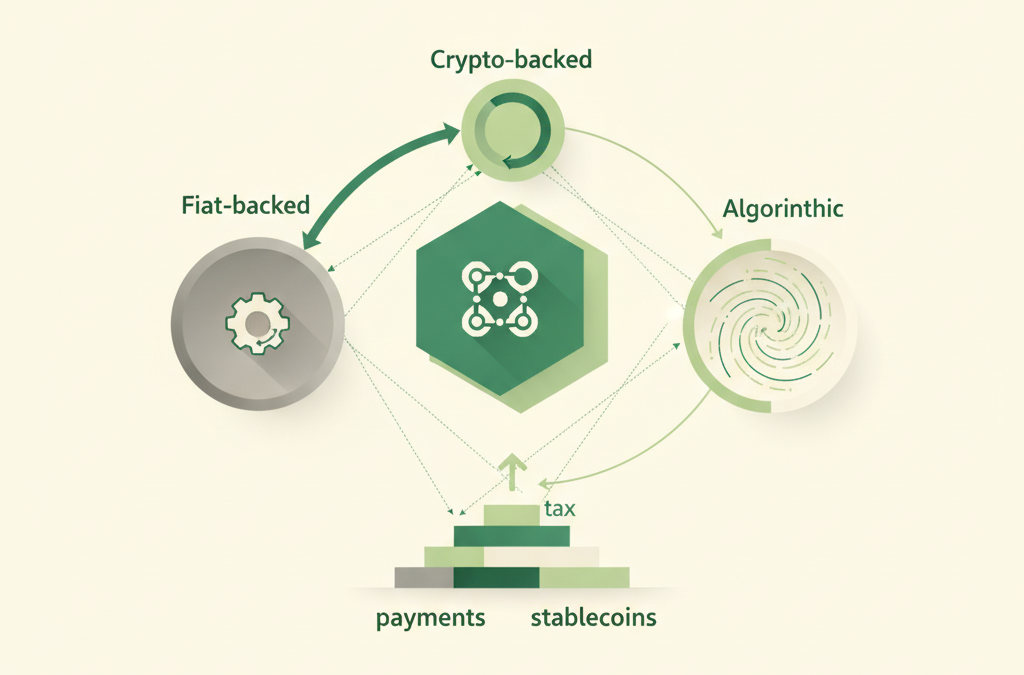
Fiat-backed vs crypto-backed vs algorithmic
Fiat-backed vs crypto-backed vs algorithmic stablecoins compared: where each gets its value, who you have to trust, and the key vulnerability of every model.
Not advice. This is educational information, not financial, investment, or tax advice. Rules differ by country and change often — consult a qualified professional in your jurisdiction before acting. See our risk disclaimer.
Quick answer
All three chase a steady value from different footings. Fiat-backed tokens lean on off-chain reserves and redemption. Crypto-backed ones lock volatile collateral on-chain and overcollateralise. Algorithmic ones ride supply rules and incentives, with little real backing. None removes risk — each just relocates it.
Key points
- Three families: fiat-backed, crypto-backed, algorithmic
- Fiat-backed concentrates trust in an issuer and its reserves
- Crypto-backed swaps that for volatile collateral and liquidations
- Algorithmic leans on confidence and has a documented failure mode
- Real tokens can be hybrids, so trace what actually backs each one
Fiat-backed, crypto-backed, algorithmic. Those are the three broad families of stablecoins, and while they all chase the same thing — a steady value against something like the US dollar — they get there by very different roads. The differences are not cosmetic. They change where the value actually comes from, what can break, and how much you are trusting a company versus trusting a piece of code. This piece compares the three neutrally, so you can look at any stablecoin’s design and read it with a clearer eye.
Why bother with the distinction at all? Because “stablecoin” names an ambition, not a promise. Two tokens can both aim for a dollar, both trade near it most days, and still rest on foundations with almost nothing in common — one on a firm’s bank reserves, one on volatile collateral and code, a third on nothing sturdier than market confidence. When markets are calm they look interchangeable. Stress is what pulls them apart. And by the time stress arrives, it is too late to start asking what holds the price together. Knowing the families in advance is what lets you read a token’s real risk instead of its marketing copy.
Fiat-backed (reserve-backed) stablecoins
A fiat-backed stablecoin holds reserves of traditional assets — usually cash and short-dated government securities — and issues tokens it promises to redeem for fiat at par. The idea is plain enough. Each token in circulation is supposed to be matched by real assets sitting off-chain, so the token tracks the reference currency.
Whether that actually holds up comes down to a few practical questions. Are the reserves genuinely safe and liquid, or is there riskier, harder-to-sell stuff mixed in? Can you really redeem — fast, and in enough size — or is redemption gated behind minimums and eligibility rules? And who is holding the reserves, with what happening if that bank or custodian gets into trouble? The answers differ from issuer to issuer and shift over time. So the sensible habit is boring but reliable: read each issuer’s own reserve reports and redemption terms yourself. A published report helps. It only goes so far — see what reserve attestations do and don’t prove.
Main trade-off: operationally simple, and usually the calmest in normal conditions — but you are trusting an off-chain issuer, the reserve choices it makes, and whoever custodies the money.
Crypto-backed stablecoins
A crypto-backed stablecoin is collateralised by other crypto assets locked in smart contracts, not by fiat in a bank. And because that collateral is itself volatile, these systems are overcollateralised: to mint a given amount of stablecoin you lock up collateral worth more than you get out, which builds in a buffer. If the collateral’s value slides toward the amount borrowed, the position gets automatically liquidated — the collateral is sold off to keep the system solvent and the stablecoin fully backed.
The appeal is openness. The collateral and the rules are visible on-chain, and you do not have to trust one company to be sitting on the fiat it claims. The cost is direct exposure to crypto-market swings. In a sharp, fast drop, liquidations can lag or clear at ugly prices, and if the collateral is piled into a handful of assets, the system just inherits their risks. Some crypto-backed designs even lean partly on other stablecoins as collateral — which quietly passes through whatever those tokens are carrying.
Main trade-off: more transparent, less reliant on a central issuer — but backed by volatile assets, and only as sound as the liquidations that have to fire smoothly right when markets are worst.
Algorithmic stablecoins
Algorithmic stablecoins try to hold a peg with little or no real backing. They lean on rules that expand and shrink the token supply — often alongside a companion “absorber” token — to nudge the price back to target. Below target, the protocol tries to cut supply or offer arbitrage into the companion token. Above target, it expands supply.
This family carries a structural risk the others do not. Because the peg rests on confidence and incentives rather than redeemable assets, a loss of confidence can feed on itself. Holders head for the exit, the companion token gets minted in huge amounts, its value collapses, and the support the peg leaned on is simply gone. The most cited example is the May 2022 collapse of the UST algorithmic stablecoin and its companion token, which lost the peg and never came back. Not every algorithmic design is built the same way, and some mix partial collateral with algorithmic bits — but the core lesson holds. A peg propped up by confidence alone can unwind fast.
Main trade-off: capital-efficient and, in principle, highly decentralised — but historically the most fragile under stress, with a failure mode that is on the record.
Hybrids and blurred lines
Real tokens do not always sit tidily in one box. Plenty blend features — mostly collateralised but with algorithmic elements at the edges, say, or a mix of fiat reserves and crypto collateral. Others are backed largely by other stablecoins, which means they inherit those tokens’ strengths and weaknesses too. It is a chain of trust, and a chain is only as strong as its weakest link. So treat the family labels as a starting point, not a verdict. When you are looking at a specific token, it is far more useful to trace exactly what backs it and how par value gets restored than to lean on whichever category it usually gets filed under.
How each model behaves under stress differs in character, too. Fiat-backed tokens stay calm in normal weather but bury their risk inside off-chain institutions you cannot inspect. Crypto-backed tokens wear their risk out in the open on-chain — except that risk is tethered to volatile markets and to liquidation machinery that has to keep grinding through the exact moments markets go haywire. Algorithmic tokens can look elegant and efficient while things are benign, then meet their defining test the instant confidence turns. None of that crowns a winner. It just means the trouble each one faces arrives from a different direction.
Side-by-side comparison
| Fiat-backed | Crypto-backed | Algorithmic | |
|---|---|---|---|
| Backing | Fiat cash and government debt held off-chain | Crypto collateral locked on-chain, overcollateralised | Little or none; supply rules and incentive tokens |
| Who you trust | Issuer and its custodians | Smart-contract rules and collateral markets | The mechanism and continued confidence |
| Transparency | Depends on issuer disclosures | Generally visible on-chain | Rules visible, but stability is confidence-driven |
| Key vulnerability | Reserve quality, redemption access, custodian risk | Collateral volatility, liquidation lag | Confidence spirals; support token collapse |
How to read any stablecoin’s design
Rather than memorising brand names, ask any token the same handful of questions:
- What is it actually backed by, and where does that backing sit? Fiat in a bank, crypto in a contract, or mostly incentives?
- How do you get par value back? Direct redemption, on-chain liquidation, or only by selling into the market?
- Who or what has to keep working for the peg to hold? A custodian, a liquidation engine, or the crowd’s faith in a mechanism?
- What has the design done under stress? The past does not predict the future, but how something behaved during real volatility tells you plenty.
Those questions map straight onto the peg mechanisms described in how stablecoins maintain their peg.
What this means
There is no single “best” stablecoin type, and this article deliberately will not rank them or tell you which to hold — that depends on your circumstances, and it is outside what an educational piece should do. The useful takeaway is simpler. Every model relocates risk rather than removing it. Fiat-backed designs concentrate trust in an issuer and its reserves. Crypto-backed designs swap that for exposure to volatile collateral. Algorithmic designs lean on confidence in a mechanism that has failed before. And because reserve details and terms differ by issuer and can change, check each one’s own disclosures directly.
Regulation of these models varies by jurisdiction and is still developing, so treat this as general education — not investment, legal, or tax advice — and talk to a qualified professional about your own situation. For the policy picture, see how stablecoin regulation is developing.
Sources
Frequently asked questions
What is the main difference between fiat-backed and crypto-backed stablecoins?
Fiat-backed tokens hold traditional reserves off-chain and rely on redemption at par, so you trust an issuer. Crypto-backed tokens lock volatile crypto collateral on-chain and stay overcollateralised, so you rely on smart-contract rules and liquidations instead.
Are algorithmic stablecoins backed by anything?
Often little or nothing directly. They use supply-adjusting rules and a companion token to steer the price. Because the peg rests on confidence rather than redeemable assets, it can unwind quickly, as the 2022 UST collapse showed.
Which type of stablecoin is safest?
There is no universal answer, and this is educational content rather than a recommendation. Each design shifts risk to a different place, and details differ by issuer, so read each token's own disclosures and terms directly.
Related

How stablecoin regulation is developing
How stablecoin regulation is developing: the EU's MiCA, the evolving US approach, and common themes of reserves, redemption and disclosure…

Why bank transfers to exchanges get blocked
Why bank transfers to crypto exchanges get blocked: name mismatches, bank policies, verification limits and fraud checks, and how to…
what is fiat currency
Discover the definition and workings of fiat currency, a government-backed legal tender, and understand how it differs from commodity-backed money.