How on-ramps and off-ramps actually work
How crypto on-ramps and off-ramps actually work: the identity checks, payment rails, pricing layers and blockchain steps behind every buy and cash-out.
Not advice. This is educational information, not financial, investment, or tax advice. Rules differ by country and change often — consult a qualified professional in your jurisdiction before acting. See our risk disclaimer.
Quick answer
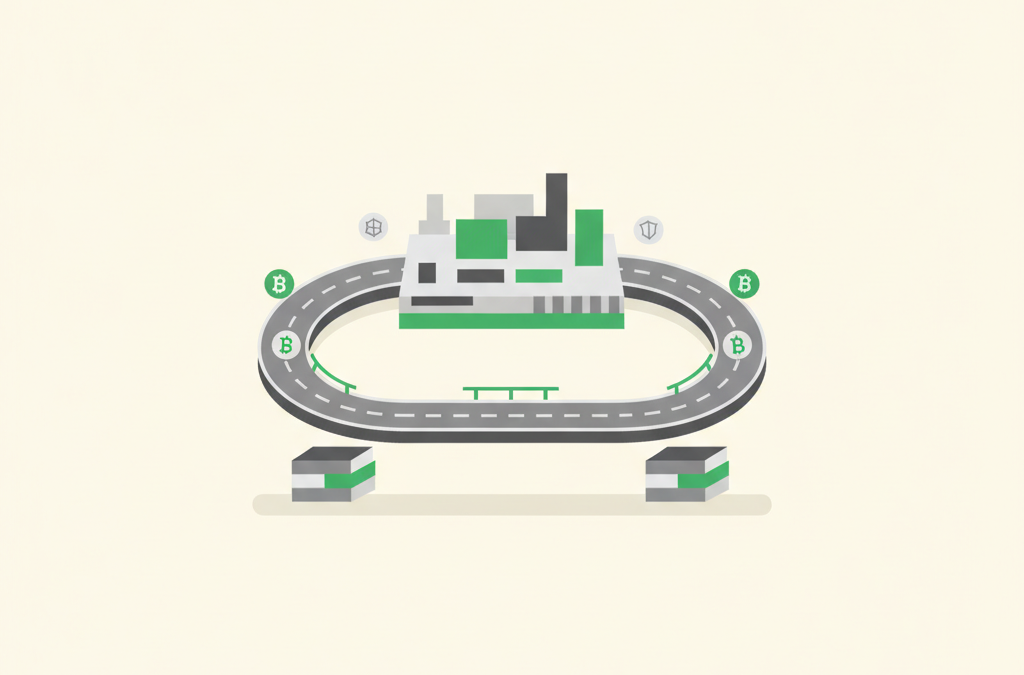
An on-ramp converts government money into crypto and an off-ramp converts it back. Behind a single buy or sell button, a regulated provider verifies your identity, takes your payment, prices the trade, sources the asset and records it on a blockchain, each step adding potential cost or delay.
Key points
- On-ramps turn money into crypto; off-ramps turn crypto back into money.
- A ramp bundles identity checks, payment rails, a treasury desk and a blockchain.
- Custodial ramps hold your keys; non-custodial ramps deliver coins to your own wallet.
- Quotes stack a market rate, spread, payment fee and network fee, so compare what you receive.
- Off-ramp delays are usually the final bank payout, not the blockchain.
An on-ramp is any service that turns government-issued money (dollars, euros, rupees) into cryptocurrency. An off-ramp does the reverse, converting crypto back into money you can spend or withdraw to a bank account. Together they are the bridges between the traditional financial system and blockchain networks, and understanding how they work explains most of the friction people run into when they first move funds.
What a ramp actually does
When you buy crypto with a card or bank transfer, you are not usually reaching into a blockchain yourself. You are handing money to a regulated business that already holds crypto, and it sends the equivalent amount to your wallet. That business sits between three worlds at once: the card networks and banks that move your currency, its own trading and treasury systems that source the crypto, and the blockchain that finally records the transfer.
A ramp therefore performs several jobs in sequence: it verifies who you are, accepts your payment, prices the trade, sources the asset, and pushes the coins on-chain (or, for an off-ramp, receives your coins and pays out money). Each of those steps is a place where a transaction can be delayed, priced differently, or declined. Ramps are operated by exchanges, standalone providers embedded inside apps and wallets, and payment companies that add a crypto-buying widget to their checkout.
Custodial versus non-custodial ramps
The single biggest distinction is who holds the coins after you buy. With a custodial ramp, typically an exchange, the provider keeps your crypto in an account it controls. You see a balance, but the private keys belong to the platform. That is convenient and reversible if you forget a password, but it means you are trusting the custodian.
With a non-custodial ramp, the provider delivers coins straight to a wallet whose keys only you hold. Many wallet apps embed a third-party ramp so you can buy directly into self-custody. The trade-off is responsibility: once the coins land in your wallet, no one can reverse a mistake for you. Neither model is universally “better”; they suit different needs, and this article does not recommend one over the other.
Ramps also do not all look the same from the outside, even though they do similar work underneath. It helps to recognise the main forms:
- Exchange ramps. You open an account on a trading platform, deposit money, and buy. The exchange is both the ramp and the custodian, and it usually offers the widest range of assets and payment methods.
- Embedded widget ramps. A wallet, game, or app drops in a third-party “buy crypto” panel. You may never realise a separate regulated company is handling the purchase and delivering coins to your wallet.
- Payment-company ramps. Established payment processors add crypto buying to a checkout, leaning on the card and banking relationships they already have.
- Peer-to-peer marketplaces. A platform matches buyers and sellers directly and escrows the crypto while payment clears. These shift more responsibility, and more risk, onto the individuals involved.
The form you use changes the experience, which payment methods are available, how much verification is asked for, and whether the coins land in your own wallet or the provider’s, but the underlying sequence of verify, pay, price, source, and deliver is the same in every case.
The identity and compliance layer
Before a ramp will move money it almost always runs Know Your Customer (KYC) checks: your name, date of birth, an identity document, sometimes a selfie or proof of address. This is not the provider being awkward. Businesses that convert between money and crypto are treated in many countries as regulated financial institutions, often called Virtual Asset Service Providers, and are expected to identify customers and monitor for money laundering. The global standard-setter for these rules is the Financial Action Task Force, whose recommendations most national regulators build on.
Because these obligations are set nationally, the documents a ramp asks for, the limits it applies, and even whether it operates in your country at all can vary widely. Rules differ by jurisdiction and providers change their terms, so treat any specific limit or requirement as something to confirm with the provider and, where money or tax is involved, with a qualified professional. This publication is educational and does not give financial, legal, or tax advice.
How pricing is put together
The number you pay is rarely just “the market price.” A ramp quote is usually built from several components stacked together:
- The reference market rate the provider sources the asset at, which moves constantly.
- A spread, a small markup between the buy and sell price that compensates the provider for taking the other side of the trade.
- A payment-method fee, because card payments, instant bank transfers, and standard transfers cost the provider different amounts to process.
- A network fee to actually broadcast the transaction on the blockchain, which the ramp may pass on or absorb.
- Currency conversion, if your money is in a different currency from the one the provider settles in.
Because these pieces are bundled, two ramps can show very different totals for the same purchase. The honest way to compare is to look at the all-in amount of crypto you receive for a fixed amount of money, not any single advertised percentage. We deliberately avoid quoting fee figures here because they change per provider, per method, and per day.
What happens on an off-ramp
Cashing out reverses the flow but adds its own checks. You send crypto to the provider, it confirms the transaction on-chain, converts it to currency at a quoted rate, and initiates a payout to your bank or card. Two things commonly slow this down. First, the provider waits for enough blockchain confirmations before crediting you, which can take minutes to longer depending on the network. Second, the payout leg travels over the ordinary banking rails, so it inherits banking hours, cut-off times, and the receiving bank’s own review. If a withdrawal seems stuck, it is often sitting in that final bank step rather than on the blockchain. Our companion piece on settlement times across networks explains the on-chain part in more detail.
Common mistakes to avoid
Most avoidable trouble with ramps comes from a few predictable missteps. Sending crypto on the wrong network, for instance choosing a network your receiving wallet does not support, can leave funds hard to recover, so the network chosen at withdrawal has to match the receiving side. Mistyping or pasting a wrong wallet address is unforgiving because blockchain transfers are final and cannot be reversed by the provider. Ignoring the minimum-confirmation wait and assuming a transfer has failed when it is simply still settling leads people to send twice. And chasing the lowest advertised fee while overlooking a wide spread can mean receiving less crypto overall. None of these are exotic; they are the everyday friction points that a little patience and double-checking prevent.
Beyond outright mistakes, even a straightforward purchase can stall. Common reasons include an identity check that needs a clearer document, a card issuer that blocks crypto-related merchants, a bank that flags an unusual transfer, or a provider limit you have hit for the day or month. None of these means the money is lost; it usually means one of the layers, identity, payment, or blockchain, is waiting on something. If a bank transfer specifically keeps failing, our article on why bank transfers to exchanges get blocked walks through the likely causes.
What this means
On-ramps and off-ramps feel like a single “buy” or “sell” button, but underneath they coordinate identity checks, payment networks, treasury desks, and a blockchain, each with its own rules and timing. Knowing that helps you read a quote honestly (look at what you actually receive), set realistic expectations for how long a cash-out takes, and understand why a provider asks for documents. Because the specifics depend on where you live and which provider you use, confirm the details directly with the service and speak to a qualified professional for anything touching tax or your personal finances.
Sources
Frequently asked questions
What is the difference between an on-ramp and an off-ramp?
An on-ramp converts government money into cryptocurrency; an off-ramp converts crypto back into money you can withdraw. They are the two directions of the same bridge between banks and blockchains.
Why do ramps ask for my identity documents?
Businesses that convert between money and crypto are treated as regulated financial institutions in many countries and must verify customers under anti-money-laundering rules. The exact documents required vary by jurisdiction and provider.
Why is the price I pay higher than the market rate?
A ramp quote bundles the market rate with a spread, a payment-method fee, a blockchain network fee, and sometimes currency conversion. Compare the total crypto you receive rather than any single advertised figure.
Related

Record-keeping requirements for crypto
Crypto record-keeping explained: what to log for every transaction - dates, amounts, fiat values, fees - and why good records…
What the Travel Rule requires
What the crypto Travel Rule requires: the sender and recipient details regulated services must share on transfers, and how self-custody…
Cost basis methods explained
Crypto cost basis methods explained: what FIFO, LIFO, HIFO, specific identification, and pooling mean, and how each one changes the…