What Does “Irreversible” Mean in Cryptocurrency Transactions
Today, sending crypto feels a lot like making any other online payment. You enter an amount, check the details and confirm. What happens next is quite…
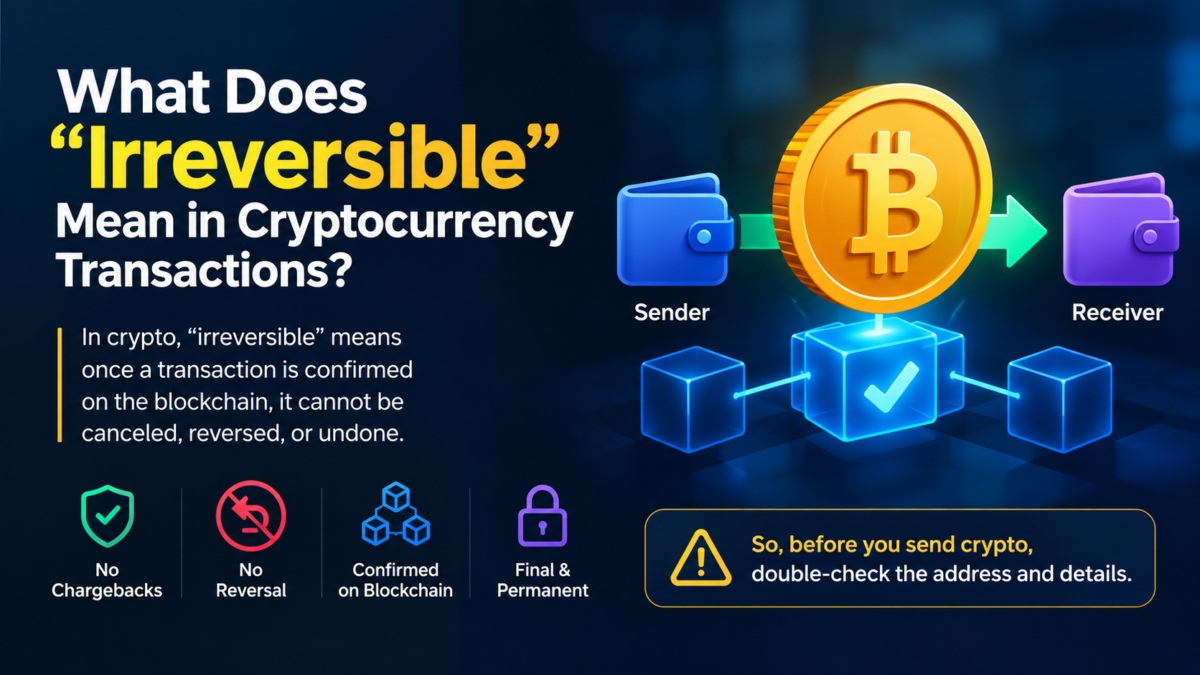
Today, sending crypto feels a lot like making any other online payment. You enter an amount, check the details and confirm.
What happens next is quite different.
With many traditional payment methods, there’s still an institution somewhere in the chain that can investigate a problem or, in some cases, reverse a payment. A blockchain transaction usually doesn’t work that way. Once it’s been confirmed strongly enough by the network, there’s generally no bank, card company or central administrator that can pull it back.
That’s what people mean when they say crypto transactions are irreversible.
Irreversible doesn’t mean instant
There’s an important distinction here.
Different blockchains confirm and finalize transactions in different ways, so a transaction might not become final as soon as you press “send”.
On Bitcoin, a transaction has to be included in a block first, with the blocks added afterward creating further confirmations. This makes reversal progressively less practical. Bitcoin’s own documentation describes confirmed payments as irreversible and notes that a refund has to come from the person who received the funds.
Ethereum handles this a little differently. Blocks don’t become final straight away. The network first has to reach agreement around them. After that point, reversing a block would mean sacrificing a very large amount of staked ETH, which makes an ordinary rollback extremely unlikely.
So “irreversible” is useful shorthand, but it skips a step. The real question is whether the transaction has reached a point where reversal is no longer realistically available through normal network operation.
Cards have someone in the middle
Compare that with paying by credit card.
A card transaction passes through a system with issuers, merchants and payment networks. If there’s a billing error, an unauthorized payment or a qualifying dispute over goods or services, there may be a formal process for challenging the charge.
In the United States, for example, cardholders can dispute certain charges, and an issuer may reverse a charge in some circumstances. Deadlines and conditions still apply.
That changes what happens when something goes wrong.
If a merchant charges you twice, there’s a dispute channel. If a payment is unauthorized, there may be a formal way to challenge it. None of this guarantees a refund, but there is an administrative layer between the customer and the final outcome.
Public blockchains deliberately remove much of that layer.
Bank payments sit somewhere else again
Bank transfers aren’t all alike either.
Some payment systems allow a transfer to be cancelled while it’s still pending. Others have procedures for dealing with errors or unauthorized transfers. Banks may also investigate certain payments and correct them when account rules or consumer law require it.
This is why it’s misleading to split payments into only “crypto” and “normal money.” Card payments, bank transfers and blockchain transfers each have their own rules around settlement and disputes.
Most people don’t spend much time thinking about those differences. Then a payment goes to the wrong place.
The ugly moment after a wrong address
A wallet address isn’t very forgiving.
Suppose you mean to send funds to one address but paste another valid address instead. The blockchain doesn’t know you made a mistake. It sees a properly signed transaction telling the network to move funds from one address to another.
If the transaction becomes final, there’s no customer-service desk inside the blockchain.
The recipient can send the money back. An exchange or merchant might voluntarily issue a refund. A custodial service may have its own internal procedures too. Those are separate actions, though. They don’t erase the original blockchain transaction.
The distinction feels fairly abstract until you’re staring at a transaction hash and realizing you copied the wrong address from another window.
Refunds still exist
Irreversibility sometimes gets interpreted too broadly.
It doesn’t mean a business accepting cryptocurrency can’t give refunds.
It means the original transaction isn’t simply rolled backward by an intermediary. If a merchant agrees to refund a purchase, the merchant normally sends a new transaction back to the customer.
Both payments then remain visible in the transaction history.
The same issue comes up across online services. Someone paying for software, hosting, digital subscriptions or Bet Jordan online casino games may have access to cards, bank transfers or crypto, depending on the service and jurisdiction. Those methods can look similar at checkout while offering very different options later if a payment is disputed or sent incorrectly.
You often notice the payment rail only after the payment has already left.
Why blockchains work this way
Irreversibility isn’t an accidental flaw in blockchain payments.
A decentralized network needs a way for participants to agree that a transaction history has settled. If confirmed payments could routinely be rewritten by a central operator, the system would start looking much more like the financial networks blockchains were built to operate without.
There’s a trade-off.
Merchants can receive payments without relying on a card company to approve every transaction or facing the same kind of chargeback process afterward. Users take on more responsibility for checking the address, amount and network before sending anything.
Neither side gets every advantage.
There isn’t one universal crypto experience either. Someone withdrawing funds from an exchange may have account-level support available before a transaction reaches the blockchain. Someone sending coins directly from a self-custody wallet has far fewer layers between the “send” button and final settlement.
The confirmation screen matters
Traditional payment systems have trained people to expect that many mistakes can be corrected later.
Crypto changes that habit.
Before confirming a transfer, the useful checks are painfully ordinary: the destination address, the network and the amount. With larger transfers, people often send a small test payment first and wait for it to arrive before moving the rest.
It’s not sophisticated. It’s just cheaper than discovering afterward that the blockchain did exactly what you told it to do.