Cost basis methods explained
Crypto cost basis methods explained: what FIFO, LIFO, HIFO, specific identification, and pooling mean, and how each one changes the taxable gain you report.
Not advice. This is educational information, not financial, investment, or tax advice. Rules differ by country and change often — consult a qualified professional in your jurisdiction before acting. See our risk disclaimer.
Quick answer
Cost basis is what a cryptoasset cost you for tax, used to measure gains and losses. When you hold the same asset bought at different prices, methods such as FIFO, HIFO, specific identification, or pooling decide which units you disposed of. Options are limited, and sometimes prescribed, by your jurisdiction.
Key points
- Cost basis is what an asset cost you for tax purposes
- Methods decide which units you are treated as disposing of
- FIFO, LIFO, HIFO, specific ID, and pooling differ
- The method mainly shifts the timing of gains
- Some countries prescribe the method, such as UK pooling
Cost basis is what a cryptoasset “cost” you for tax purposes — normally the price you paid plus certain associated costs. When you dispose of the asset, your gain or loss is measured against this figure, so the way you calculate cost basis directly shapes the number you report.
This article explains the common cost basis methods and why they can produce different results. It is educational only, not tax advice. Which methods are permitted, and how they must be applied, differs by country and changes over time, so treat the examples as illustrations and consult a qualified tax professional in your jurisdiction.
Why cost basis exists at all
Because crypto is usually treated as property, a disposal compares two numbers: the value you received and the cost basis of the specific units you disposed of. If you only ever bought one lump of a coin at one price, there is no ambiguity. The complication appears when you acquired the same asset at different times and prices. Now, when you sell part of your holding, which units did you sell? That question is what cost basis methods answer.
The common methods
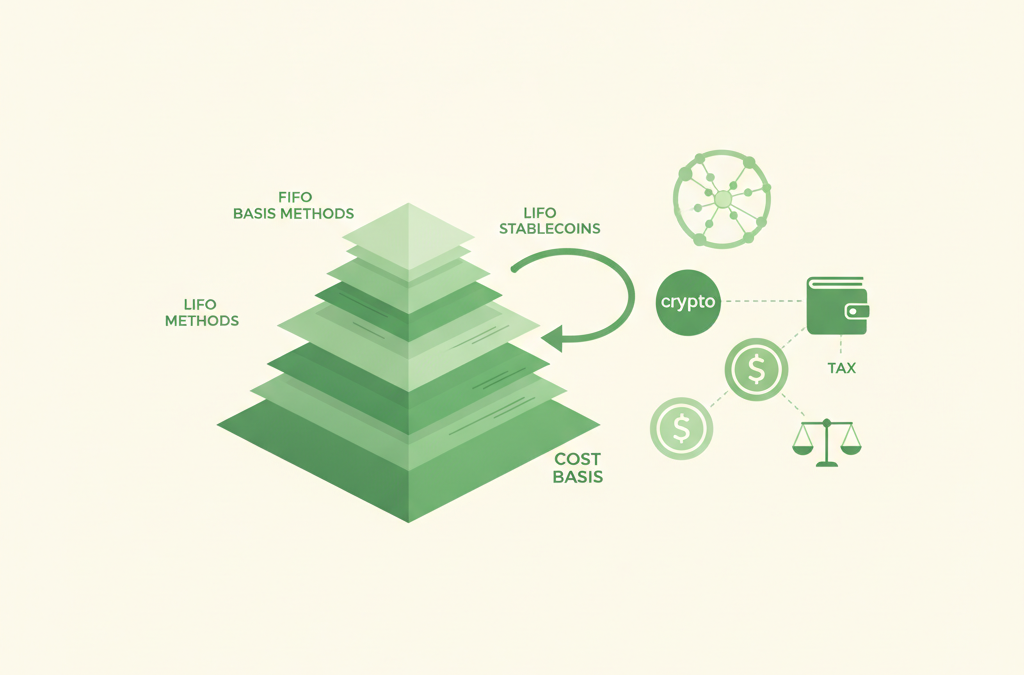
- FIFO (first in, first out). You are treated as disposing of the oldest units first. Simple and widely used; often the default where a method is not specified.
- LIFO (last in, first out). You are treated as disposing of the most recently acquired units first. Permitted in some contexts and not others.
- HIFO (highest in, first out). You are treated as disposing of the highest-cost units first. Where allowed, it tends to reduce the immediate gain, but it leaves lower-cost units in your holding for later.
- Specific identification. You identify exactly which units you are disposing of, provided you can document them adequately. This offers the most control but demands the strongest records.
- Average cost / pooling. Units of the same asset are grouped and given an averaged cost. Some jurisdictions build their whole approach around pooling rather than picking individual lots.
How the method changes the result
Consider the concept with round, illustrative figures. Suppose you bought one unit of a token for 100 and later a second unit for 300, then sold one unit for 400. Under FIFO you are treated as selling the 100-cost unit, giving a 300 gain now, and you still hold the 300-cost unit. Under a highest-in approach you are treated as selling the 300-cost unit, giving a 100 gain now, and you still hold the 100-cost unit. The total gain across the whole holding is the same once everything is eventually sold — what changes is the timing of when gains appear. These numbers are illustrative only and not tax rates or thresholds.
That timing effect is why the method matters. It does not conjure gains out of nothing over the life of the holding, but it can move gain into or out of a particular tax year, which can interact with allowances, rates, and losses.
Cost basis is not only about price; each lot also carries a date, and dates can matter as much as prices. Some systems tax gains differently depending on how long you held the disposed units, so choosing which lot you are treated as selling can change not just the size of the gain but its character. A method that disposes of the oldest units first, for instance, may reach units held long enough to qualify for different treatment than the newest units would. This is another reason the method and the records behind it are inseparable: without accurate acquisition dates, you cannot even determine holding periods, let alone apply them. The specific holding-period rules and any preferential treatment vary by country and change, so they are described here only as a principle.
Illustrative examples: the United States and the United Kingdom
In the US (illustrative only), crypto is property under IRS Notice 2014-21, and taxpayers have generally been able to use specific identification when they can adequately identify the units disposed of, defaulting to first-in-first-out otherwise. The IRS FAQ on virtual currency transactions discusses how to determine basis and which units are treated as sold. Rules on how identification must be documented and applied have been tightening, so this is an area to check against current guidance rather than older summaries.
In the UK (illustrative only), individuals do not freely pick FIFO or HIFO. HMRC’s Cryptoassets Manual requires a pooling approach: tokens of the same type are grouped into a “section 104 pool” with an averaged cost, overlaid by same-day and 30-day matching rules that take priority for disposals close to acquisitions. This means the UK answer to “which units did I sell?” is largely prescribed rather than chosen, and it can differ substantially from a simple FIFO calculation.
Fees, and what else can sit in cost basis
Cost basis is often more than the raw purchase price. In many systems, acquisition costs directly tied to obtaining the asset — such as certain transaction or network fees — can be added to basis, while costs of disposal can reduce the proceeds. The precise treatment of fees varies, but the principle is worth holding onto: fees are not always simply lost; they can adjust the numbers that decide your gain. This is another reason to record fees carefully alongside every transaction.
Reward tokens add a further wrinkle. When crypto arrives as income — for example, as payment or, in some systems, as staking rewards — the value taxed as income typically becomes the cost basis of those exact tokens. So the “cost” of a coin is not always something you paid in fiat; sometimes it is the amount already counted as income when you received it. Mixing purchased units and reward units of the same token is where cost basis tracking gets genuinely fiddly.
Why consistency and lot tracking matter
Whatever method applies, tax authorities generally expect it to be applied coherently rather than cherry-picked sale by sale. Where specific identification is allowed, its power comes entirely from your ability to point at particular lots and prove their acquisition details; without that evidence, you typically fall back to a default such as first-in-first-out. Where pooling is mandated, the averaging is done for you, but only if your pool is built from complete records. In every case the method is a set of instructions for choosing units, and it can only run on data you actually kept.
Two practical principles show up across systems. First, you generally cannot use whichever method gives the best answer on each individual sale; jurisdictions expect a coherent, documented approach, and some prescribe the method for you. Second, whichever method applies, it only works if your records are complete: acquisition dates, amounts, and fiat values for every lot. Without those, even a permitted method such as specific identification simply cannot be supported.
What this means
Cost basis is the anchor that a gain or loss is measured against, and the method decides which units you are treated as disposing of when you hold the same asset at different prices. Methods mostly shift the timing of gains rather than erase them, and your options are constrained — sometimes fully prescribed — by where you are. Because the permitted methods and documentation standards genuinely differ by country and change, confirm the correct approach with a qualified tax professional in your jurisdiction. For the wider framework, see how crypto is taxed and what counts as a taxable event.
Sources
Frequently asked questions
What is cost basis for crypto?
Cost basis is what a cryptoasset cost you for tax purposes, normally the price paid plus certain associated costs. When you dispose of the asset, your gain or loss is measured against this figure.
Can I choose FIFO, LIFO or HIFO for my crypto?
It depends on your jurisdiction. Some systems allow specific identification or various methods if you can document them; others, such as the UK, prescribe pooling with matching rules. You generally cannot pick a different method for each sale.
Does the cost basis method change how much tax I owe overall?
Mostly it changes the timing of gains rather than the lifetime total, since all units are eventually accounted for. But shifting a gain into a different year can interact with allowances, rates and losses, so the yearly effect can be real.
Related

What Is Restaking in Crypto?
Restaking reuses already-staked crypto to help secure extra protocols for additional yield, stacking new slashing and smart-contract risks on top.
What is DeFi (decentralised finance)?
DeFi (decentralised finance) rebuilds lending, borrowing and trading as open smart contracts on public blockchains. Learn how it works and…

What is yield farming?
Yield farming means supplying crypto to DeFi protocols to earn fees and reward tokens. Learn how it works, where the…