What Is a Crypto Derivative?
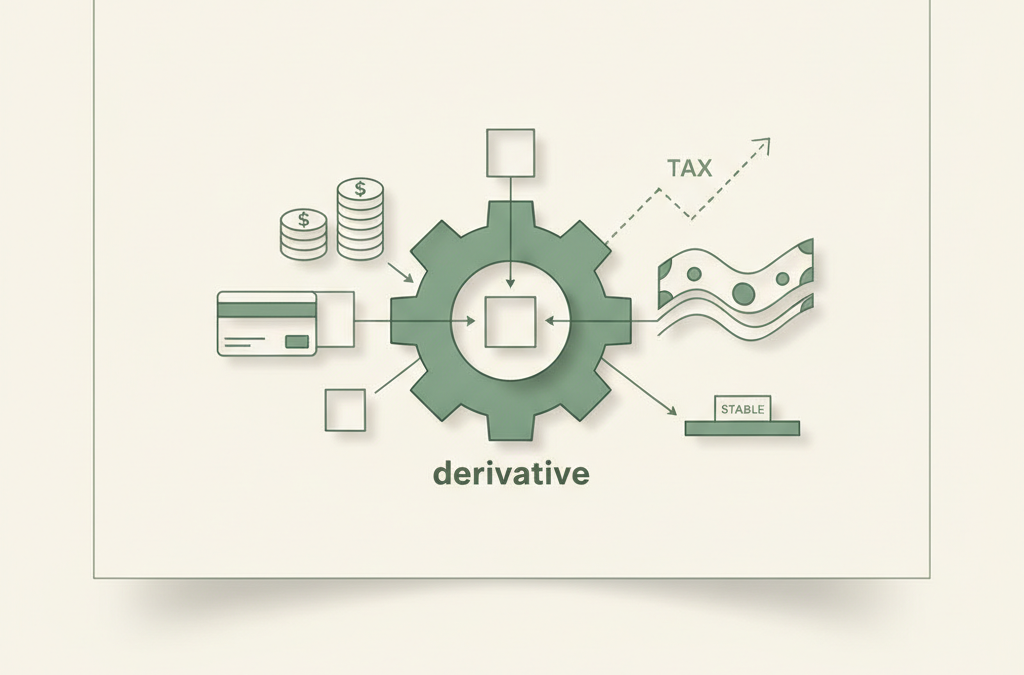
A crypto derivative is a contract whose value derives from an underlying coin's price, used to speculate or hedge without owning the coin itself.
Not advice. This is educational information, not financial, investment, or tax advice. Rules differ by country and change often — consult a qualified professional in your jurisdiction before acting. See our risk disclaimer.
Quick answer
A crypto derivative is a financial contract whose value comes from the price of an underlying cryptocurrency, such as Bitcoin or Ether, rather than from owning the coin. Traders use derivatives like futures, options, and perpetual swaps to bet on price moves or to hedge existing holdings without holding the asset directly.
Key points
- A crypto derivative derives its value from an underlying coin's price and does not require owning that coin.
- The main types are futures, options, perpetual swaps, and contracts for difference.
- Perpetual swaps have no expiry and use a funding rate to keep their price near the spot price.
- Most derivatives use leverage, which multiplies both gains and losses relative to the money put up.
- In the United States the CFTC treats Bitcoin and similar assets as commodities and regulates their derivatives.
- Leverage and liquidation make derivatives higher risk than simply buying and holding the underlying coin.
A crypto derivative is a financial contract whose value comes from, or is derived from, the price of an underlying cryptocurrency such as Bitcoin or Ether, rather than from owning the coin itself. Traders use it to bet on where a price is heading, or to hedge holdings they already have, without holding the underlying asset directly.
The word derivative is old and broad. Stocks, bonds, commodities, currencies, and interest rates all have derivatives; crypto simply added coins to the list of things a contract can track. This is an educational explainer, not financial advice, and the rules around these instruments differ sharply by jurisdiction. Consult a qualified professional before acting.
What does a crypto derivative actually do?
It separates price exposure from ownership. Buy a coin outright and you own an asset. Buy a derivative and you own a contract whose payoff rises or falls with that coin’s price, while the coin itself stays somewhere else, or is never held at all.
That separation is the whole reason derivatives exist. A miner who wants to lock in tomorrow’s price, or a fund that wants to hedge a holding without selling it, can do so with a contract. Speculators, meanwhile, use the same contracts to take a view on price with less money down.
What are the main types of crypto derivatives?
Four show up most often, and each behaves differently.
Futures. A standardized contract to buy or sell a coin at a set price on a set future date. When the date arrives, the contract settles, and its price must meet the spot price.
Options. A contract giving the holder the right, but not the obligation, to buy or sell at a set price before a set date. The buyer pays a premium for that choice.
Perpetual swaps. Futures with no expiry. Because nothing forces convergence, they use a funding rate, a periodic payment between longs and shorts, to keep the contract price anchored near spot. Perps are the dominant crypto derivative by volume.
Contracts for difference. A simple agreement to exchange the difference between a coin’s entry and exit price, common with some brokers and banned or restricted in several countries.
How do the types compare?
The differences matter more than the shared label. This table lines them up.
| Type | Expiry | Obligation | Key feature |
|---|---|---|---|
| Future | Fixed date | Both sides must settle | Price converges to spot at expiry |
| Option | Fixed date | Holder may choose | Buyer pays a premium for the right |
| Perpetual swap | None | Held until closed | Funding rate anchors price to spot |
| CFD | None fixed | Both sides settle the difference | Broker-based, often restricted |
What is leverage, and why does it dominate the story?
Leverage lets a trader control a large position with a small deposit called margin. Put up a fraction of the value, and the contract behaves as if you held the full amount. That is the appeal, and the trap.
Because leverage scales both directions, a modest price move against you can wipe out the margin entirely. When that happens the position is liquidated, closed automatically to stop losses from going further. This is where inexperienced traders lose money fastest, and it happens quietly and quickly.
On perpetual swaps, funding adds a second cost. If funding runs against your side for a while, you keep paying it just to hold the position open, even when the price has not moved.
How are crypto derivatives regulated?
That depends entirely on where you are. In the United States the Commodity Futures Trading Commission treats Bitcoin and similar assets as commodities, which puts their futures and options under its oversight, with the same category of protections that apply to gold or oil futures.
Other regions draw the lines differently. Some restrict or ban retail access to high-leverage products; others authorize venues under their own frameworks. Eligibility, available leverage, and investor protections all shift with your jurisdiction, so a product legal in one country may be off-limits in another.
Why do derivatives matter to the wider market?
They do more than let people speculate. Derivatives markets feed price discovery, because futures and perpetuals often trade in enormous volume and reflect where traders think prices are going. They also let long-term holders hedge, smoothing risk without forcing a sale.
That influence has a flip side. Heavy leverage can amplify moves: a sharp drop can trigger cascading liquidations, which push prices down further, which trigger more liquidations. The tail can wag the dog.
What are the risks and misconceptions?
The biggest misconception is that a derivative is just a cheaper way to buy a coin. It is not. It is a leveraged contract with its own costs and failure modes.
Amplified losses. Leverage multiplies the downside as readily as the upside.
Liquidation. A small adverse move can close your whole position and take the margin with it.
Funding drag. On perps, holding a position can cost money over time even when the price is flat.
Counterparty risk. Your margin sits with an exchange or broker; if that venue fails, the contract may be worthless.
Hedging or speculating: what is the split?
Derivatives serve two very different masters. A hedger already owns something and uses a contract to reduce risk, like a holder who shorts futures to protect against a fall without selling coins. The goal is safety, not profit from the contract itself.
A speculator owns nothing underneath and uses the contract to take a view, hoping the price moves their way. Same instrument, opposite intent. One is buying insurance; the other is placing a bet.
Most crypto derivative volume leans toward speculation, which is part of why these markets can move so sharply. Working out which role you would be playing is the first step to understanding the risk you would be taking on.
The bottom line
A crypto derivative is a contract that tracks a coin’s price without requiring you to own the coin, delivered mainly as futures, options, perpetual swaps, and CFDs. Leverage makes these instruments powerful for hedging and speculation, and dangerous for anyone who underestimates liquidation and funding costs. This piece describes how the mechanism works and where the risks concentrate. It is not advice, and the rules governing these products vary widely from one country to the next.
Sources
Frequently asked questions
What is the difference between a future and a perpetual swap?
A dated future settles on a fixed expiry date, when its price must meet the spot price. A perpetual swap never expires; instead a funding rate is paid between long and short traders to keep its price anchored close to spot.
What does leverage mean in crypto derivatives?
Leverage lets a trader control a large position with a smaller deposit, called margin. It multiplies gains, but it multiplies losses just as fast, and a small adverse move can trigger liquidation of the whole position.
Do I own the cryptocurrency if I trade a derivative?
Usually no. A derivative is a contract about the coin's price, so you gain exposure to price moves without holding the coin. Some contracts settle in cash and others deliver the asset, but many crypto derivatives never transfer the underlying coin at all.
Who regulates crypto derivatives?
It depends on the country. In the United States the Commodity Futures Trading Commission treats major crypto assets as commodities and oversees their futures and options. Elsewhere different regulators and rules apply, so eligibility and protections vary.
Is trading crypto derivatives advice-worthy here?
No. This article explains how the instruments work and their risks. It is educational only, not financial advice, and rules differ by jurisdiction. Consult a qualified professional before making decisions.
Related
What a securities determination means in practice
What a crypto securities determination means: the US Howey test, its registration and licensing consequences, and why it differs by…

Crypto losses and how they’re handled
How are crypto losses handled for tax? Learn how realised capital losses can offset gains, why unrealised losses do nothing,…

How staking rewards are treated
How are staking rewards taxed? A clear guide to the two-layer pattern: income when you receive rewards, then capital gains…